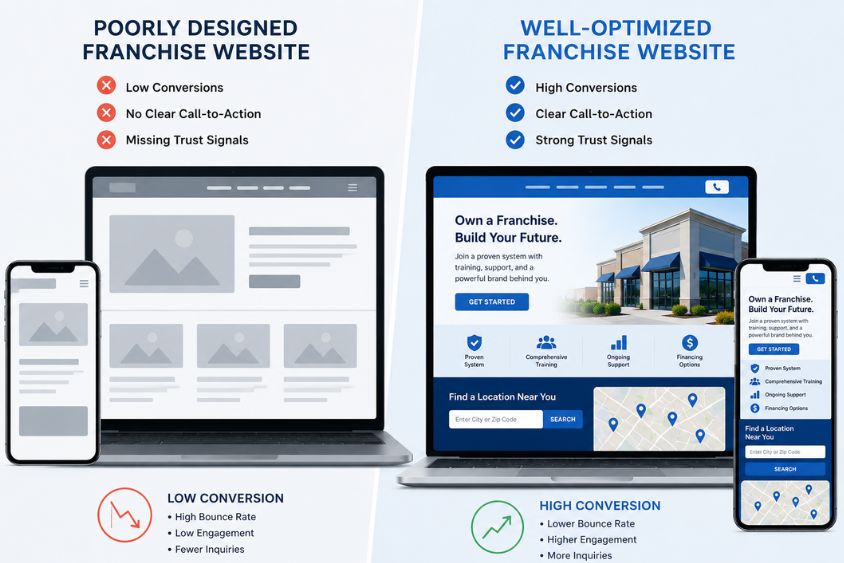
A franchise website can look polished, load cleanly on a desktop computer, and cost a significant amount to build. It can feature professional photography, a clean brand-consistent layout, and a navigation menu that impresses the marketing committee. And it can still generate almost no leads.
This is one of the most common problems franchise systems face in 2026. The website passes a visual inspection. The brand colors are correct. The pages exist. But when you look at the actual performance data, contact form submissions are thin, phone calls from the website are sparse, and the location pages are buried somewhere on page three or four of Google results. The disconnect between appearance and lead generation comes down to specific, fixable design and structure decisions that many franchise websites get wrong.
Google and AI-powered search systems now evaluate franchise websites differently than they did two or three years ago. A site that satisfied the standards of 2022 may now be actively working against your lead generation goals. The ten mistakes below are the ones ClickTecs sees most often when auditing franchise websites across North America. Each one measurably reduces leads, and each one has a clear, actionable solution.
Mistake 1: Identical Location Pages With Only The City Name Changed
Many franchise websites generate location pages by copying a single template and swapping in the city name. The rest of the text, the service descriptions, the hero copy, the FAQ answers, remains word-for-word identical across every single location page.
Google identifies near-duplicate content and reduces the ranking value of every page in that duplicate group. If your system has 80 location pages and 75 of them share the same body text, you are communicating to Google that none of them offer unique local value. AI search systems face the same problem when processing your content. When a customer asks an AI assistant for a service recommendation in their specific city, that system has no meaningful reason to surface your particular location page over any other, because every page says exactly the same thing.
Each location page needs a minimum of 300 unique words. Write about the local service area. Mention the franchisee or a team member by name. Describe location-specific services, hours, or offerings. Reference nearby landmarks or recognized neighborhoods. Include at least one real photo taken at that specific location with a descriptive alt tag. This work takes time and effort, but it pays direct dividends in both organic search ranking and AI recommendation visibility.
Mistake 2: No Click-To-Call Button In The Mobile Header
More than 70% of franchise-related searches happen on mobile devices. When a potential customer finds your location on their phone, the most common next action they want to take is call. If your phone number is not in the header as a tappable, click-to-call link, you are adding friction to a conversion that was very close to happening.
Many franchise websites bury the phone number in the footer, on a dedicated contact page, or inside an image element that does not respond to a tap. That is not a design preference. It is a direct and daily loss of inbound contacts from people who were already interested enough to find your page.
Pin a phone number with a click-to-call link directly in the sticky mobile header so it remains visible at all times, regardless of how far the visitor has scrolled. This single structural change typically increases mobile contact rates by 20% to 35% on franchise location pages. The cost to implement it is minimal. The cost of not implementing it accumulates every day your site runs without it.
Mistake 3: Contact Forms With More Than Four Fields
Every field you add to a contact form reduces your form completion rate. Research across multiple industries consistently shows that each additional form field removes 10% to 15% of the people who started filling it out. A contact form that asks for name, email, phone number, zip code, message, service type, preferred contact time, and referral source is likely cutting your submissions by 50% or more compared to a shorter version of the same form.
Your staff can gather every additional detail during the follow-up call. The website form has one job: get the prospect to raise their hand and identify themselves. Ask for name, phone number, and zip code only. Route the submission to the correct franchisee using the zip code. Collect service details, budget information, and scheduling preferences during the first conversation. Reducing your form to three fields is one of the fastest ways to increase lead volume from an existing website without rebuilding anything else.
Mistake 4: No Location Finder Or Store Locator On The Homepage
Multi-location franchise websites that require visitors to navigate dropdown menus or click through multiple pages to find their nearest location lose a significant portion of those prospects before they ever convert. A visitor who arrives on your homepage and cannot immediately identify how to find the location closest to them will often leave and try the next search result instead.
Place a simple zip code search field prominently on the homepage, ideally near or above the primary fold. Return the nearest three locations with the phone number, current hours, and a direct link to each individual location page. This eliminates a friction point at one of the most critical moments in the customer journey, which is the moment when someone decides whether your franchise system is worth their time. A visible, fast location finder communicates immediately that your system is built to serve local customers, not just to display a national brand presence.
Mistake 5: Slow Mobile Load Times
Google uses Core Web Vitals as a direct ranking factor in 2026. A franchise website that takes more than three seconds to load on a mobile connection loses approximately 40% of visitors before the page fully renders on their screen. Those visitors are not leaving because of your content, your pricing, or your brand. They never saw any of it.
Compress all images to under 200 kilobytes before uploading them to the website. Use lazy loading for any images that appear below the visible screen area on initial load. Audit your installed plugins and remove any that are not actively contributing to a conversion goal or critical function. Remove unused third-party scripts. Your technical benchmark should be a Largest Contentful Paint score under 2.5 seconds on mobile. Google Page Speed Insights will show you exactly where your current site stands and which specific changes will produce the greatest improvements for the least effort.
Mistake 6: Missing FAQ Schema On Location Pages And Blog Posts
FAQ schema is structured data markup that tells Google and AI assistants exactly which questions your pages answer and provides those answers in a machine-readable format. Without this markup, your content competes in a much noisier environment. With it, your pages become strong candidates for Google AI Overviews, featured snippets, and direct citations from AI search tools like ChatGPT when users ask questions relevant to your franchise category.
Franchise websites frequently have no FAQ content at all on location pages, and those that do rarely implement the proper schema markup that makes that content visible to AI systems. Add five to eight FAQ questions using FAQ schema markup to every location page and every blog post you publish. Write the questions using the actual language your customers use when they search, not internal terminology. You can identify these questions through Google Search Console, Google’s “People Also Ask” boxes, and by asking your franchisees what questions they receive most often by phone. This is one of the highest-return technical improvements available for franchise websites today.
Mistake 7: No Local Reviews Or Testimonials On Location Pages
A national testimonials page does not help someone who is deciding between two franchise locations near their home. When local intent drives the search, local social proof closes the deal. Generic national testimonials from customers who visited locations in other cities carry almost no persuasive weight for a prospect trying to choose a local provider.
Embed Google Reviews directly on each location page using a review widget that pulls reviews filtered to that specific location. Show the five to eight most recent reviews with reviewer names and dates visible. This tells a prospective customer that real people in their community have used this exact location and were satisfied enough to leave a review. It also signals to Google that the location page has genuine local relevance, which supports better local search rankings. The closer the social proof is to the customer’s geography and experience, the more effectively it builds the trust that converts a web visitor into a booked appointment or phone inquiry.
Mistake 8: Generic Stock Photography Instead Of Real Location Photos
Stock photography is professionally lit and easy to source, but it communicates nothing specific about your franchise location. Visitors have seen those images before, often on competitor websites, and sometimes on the very sites they compared you to moments earlier. Generic imagery signals to both human visitors and AI content evaluation systems that the page is not genuinely location-specific content.
Photograph every franchise location at or shortly after opening, while the space looks its best. A minimum useful set of photos includes ten images: the exterior from street level, the interior, staff members with their names attributed in captions, and the core product or service being actively delivered. Update these photos at least once a year to reflect staff changes, renovations, and any visual updates to the space. Real location photography is one of the most direct ways to differentiate your location pages from template-generated pages at competing systems and to demonstrate to AI indexing systems that your content is genuinely rooted in a specific place.
Mistake 9: Too Many Competing Calls To Action On The Same Page
A page that asks visitors to call now, fill out a contact form, download a guide, follow on social media, read a related blog post, and sign up for an email newsletter is asking too much from a single visitor at a single moment. When people face too many options with no clear hierarchy, they frequently choose none of them and leave. This is a well-documented psychological response to decision overload, and franchise websites are particularly prone to it because corporate teams want to promote multiple programs, generate email lists, and drive social follows all from the same location page.
Choose one primary call to action for each page and make it visually dominant in the layout. On a location page, that call to action should be a phone number or a short contact form, with nothing competing for equal visual attention. Any secondary actions should be visually subordinate, displayed with smaller type and lower visual contrast, so they do not pull the visitor’s attention away from the primary conversion path. Removing competing calls to action from location pages consistently produces measurable improvements in contact form completion rates and phone call volume.
Mistake 10: No Trust Signals Above The Fold
Trust signals establish credibility before a visitor reads a single line of your content. Without visible trust signals, your franchise website looks identical to any local business that registered a domain name and built a basic site last month. A visitor who cannot quickly identify why your franchise system is established, credible, and widely trusted has no particular reason to choose you over the next result in their search.
Place your strongest trust signal inside the hero section of every page, visible above the fold on mobile without any scrolling required. Effective options include years in business, total number of active locations across the system, your aggregate review count and average rating across all locations, or notable recognition from a relevant industry organization. Choose the signal that is most impressive and most immediately verifiable, and make it prominent in the first section every visitor sees. Visitors who see credibility signals immediately are measurably more likely to stay on the page long enough to convert into a lead.
Get A Free Franchise Website Audit From ClickTecs
ClickTecs has spent 25 years helping franchise systems build websites that generate real, measurable leads across every location in their network. If you are not certain whether your current site is making these mistakes, the clearest next step is to have an experienced team review it with specific, evidence-based criteria.
Visit https://clicktecs.net/contact/to request a free franchise website audit. We will review your location pages, mobile performance, trust signals, schema markup, form design, and contact conversion paths, and provide you with a prioritized list of what to fix first to produce the fastest improvement in lead volume.
Frequently Asked Questions
How Many Unique Words Does A Franchise Location Page Need To Rank Well In Local Search Results?
Google does not publish a specific word count requirement, but most SEO professionals working with multi-location franchise systems treat 300 unique words as the practical minimum for establishing meaningful differentiation from other location pages on the same domain. The word “unique” is the operative term. These must be words that do not appear on any other page of your website, not repurposed body copy with the city name inserted. Including the franchisee name, the specific neighborhoods served, local landmarks, location-specific operating details, and at least one location-specific FAQ answer is the most reliable way to build that uniqueness naturally. Pages with 500 or more unique words consistently outperform thinner location pages in local organic rankings, and in AI recommendation visibility for location-specific queries. If your budget allows content investment at that level, the additional depth pays dividends across both search channels.
What Is The Single Most Impactful Change A Franchise Website Can Make To Increase Mobile Lead Volume?
Adding a click-to-call phone number to the sticky mobile header produces a faster and more directly measurable result than almost any other single structural change to a franchise website. Over 70% of franchise-related local searches occur on mobile devices, and a large proportion of those searchers intend to call the business rather than complete a form. If that phone call requires more than one tap to initiate from the page they landed on, you lose a percentage of those callers every single day the site runs in its current state. The implementation is technically simple, the cost is low, and the typical improvement in mobile contact rates falls between 20% and 35% on franchise location pages. If you can only make one change to your franchise website in the near term, making it easier for mobile visitors to reach a phone call is the change most likely to produce a visible improvement in lead volume within the first two weeks.
Does FAQ Schema Markup Actually Influence Whether Franchise Content Appears In AI Search Results?
Yes, and its influence has grown substantially as AI-powered search tools have become the primary discovery channel for a growing proportion of consumers. FAQ schema tells both Google and AI assistants exactly which questions a page answers and provides the structured answers in a machine-readable format that does not require the AI to interpret paragraph text. This makes your content significantly more likely to be cited directly in Google AI Overviews, pulled as a featured snippet, or referenced in responses from tools like ChatGPT when users ask questions related to your franchise category or service area. Franchise websites without FAQ schema are competing against pages that have structured data with content that is not structured, which places them at a consistent disadvantage in AI-generated answer results. Adding five to eight FAQ entries with proper schema markup to each location page and blog post is one of the most accessible and high-return technical improvements available to franchise marketing teams today.
How Often Should Franchise Location Photos Be Updated On The Website?
Location photos should be reviewed and refreshed at minimum once per year. Staff changes, interior renovations, updated equipment, expanded service offerings, and seasonal visual changes all create opportunities to show visitors a current and accurate picture of what they will experience when they visit or call that specific location. From a search perspective, updated images with descriptive, location-specific file names and alt text send freshness signals to Google that the page is actively maintained, which supports continued ranking performance. For franchise systems in rapid growth phases, photograph new locations within the first 30 days of opening while the space looks its best and before wear from daily operations becomes visible in photos. Stock photography should be treated as a temporary placeholder only. Any location page that still carries stock imagery six months after launch is leaving measurable conversion performance unrealized.
What Is The Right Number Of Fields For A Franchise Contact Form?
Three fields is the optimal target for a franchise lead generation form: name, phone number, and zip code. Some franchise categories benefit from adding a fourth field that asks about the nature of the inquiry, particularly when different inquiry types need to route to different franchisees, departments, or booking systems. Beyond four fields, completion rates drop in a measurable and consistent pattern. Research across industries shows that each additional field beyond the minimum removes a portion of the visitors who started completing the form. A form with eight or more fields can reduce completions by 50% or more compared to a three-field version asking for the same prospect. Everything your team needs beyond those three data points, including service details, scheduling preferences, budget range, and property information, can be collected efficiently during the follow-up phone call. The website form exists to get the prospect to identify themselves. The conversation does the rest.
Why Do Trust Signals In The Hero Section Matter For Franchise Website Lead Generation?
Trust signals placed above the fold, in the hero section that is visible before any scrolling, reduce the time it takes a visitor to decide whether your franchise system warrants their continued attention. A visitor who immediately sees that your system has operated for 25 years, maintains 400 active locations, and holds a 4.8-star rating across thousands of verified customer reviews absorbs that credibility in the first seconds of the visit, before they read your service descriptions, view your pricing, or evaluate your location page content. This matters because a significant portion of website visitors make a stay-or-leave decision within the first few seconds of arrival. Trust signals that require scrolling to discover may never reach the visitors who need them most. Test different trust signal combinations in your hero section by measuring changes in time-on-page and contact form submission rates over 30-day intervals to identify which specific signal resonates most strongly with the audiences visiting your highest-traffic location pages.

CEO & Founder, ClickTecs
Jamshaid (Jam) Hashmi is a serial entrepreneur and franchise digital marketing expert with 25+ years of experience. As CEO & Founder of ClickTecs - North America's leading franchise digital marketing agency - Jam has helped 100+ franchise brands across Canada and the United States grow through SEO, PPC, social media, and AI Search strategies. Previously VP of Development at WSI, where he placed 400+ franchisees, he also co-founded FranchiseSoft, a SaaS franchise management platform. Jam sits on the Marketing & Innovation Committee of the IFA and the Canadian Franchise Association (CFA), and is a sought-after speaker on SEO, franchise lead generation, AEO, and AI for franchising.
Franchise Digital Marketing
Multi-Location SEO
Google Ads PPC
Meta Ads
View Full Profile →