
Ranking locally in a single city is difficult enough. Ranking locally in forty cities, or four hundred, while keeping every brand signal consistent and every location page credible, is a different problem entirely. Most franchise systems underestimate just how different that problem is.
The typical approach goes like this. A franchise brand builds one location page template, copies it across every market, swaps the city name into the title tag and the first paragraph, and considers the work done. It is efficient, it is fast, and it is one of the most reliably damaging mistakes in multi-location SEO. Google and AI-powered search tools both evaluate each franchise location as its own entity. The brand umbrella provides some domain authority, but it does not substitute for location-specific signals.
The stakes in 2026 are significant. Franchise brands with centralized SEO, review management, and listing oversight grew up to 74% faster in local search visibility in 2025 than networks operating without that coordination, according to SOCi’s 2026 Franchise Report. Meanwhile, Google Business Profile actions grew 41% year over year in 2025, according to Google’s own data, meaning the opportunity for franchise brands that get this right has never been larger. The brands that build strong multi-location infrastructure now will hold a substantial competitive advantage as AI search continues to reshape how local customers find service providers.
This playbook covers what it actually takes to rank well across multiple markets in 2026. The tactics here are drawn from ClickTecs’ experience managing SEO for franchise brands across North America over the past 25 years.
The Single Biggest Mistake In Multi-Location SEO
Before getting into what works, it is worth naming what does not work, because the most common mistake is so widespread that it deserves specific attention.
Copying a location page template and changing only the city name is the single biggest mistake in multi-location SEO. It is not a neutral choice. It is a debt that compounds over time.
Google’s systems are designed to identify thin, templated content. When a franchise website has 80 location pages sharing 95% of the same text, Google does not interpret that as 80 strong local signals. It interprets it as one weak signal, duplicated 80 times. Some of those pages will be suppressed entirely. Others will be indexed but not ranked for any meaningful local query. The entire location page program underperforms against what it could achieve with properly differentiated content.
Beyond search engine signals, templated location pages fail real customers. A person searching for a specific service in a specific neighborhood wants evidence that the business they are about to contact actually operates in their community. A page that could apply to any city in the country does not provide that evidence.
Location Page Best Practices That Actually Work
Every location page in a franchise system should be able to stand on its own as a credible, informative page about that specific location. The following elements are what separate location pages that rank from those that do not.
**Unique opening content specific to that location.** The first 150 words of each location page need to be written for that market, not adapted from a template. This means referencing the neighborhood or service area, the types of customers that location typically serves, and anything genuine about the local context. This does not need to be elaborate writing. It needs to be accurate and specific. Search engines and real readers both recognize when content was produced with a specific place in mind versus when it was generated from a find-and-replace operation.
**The franchisee or local team lead name where available.** Local search rewards trust signals, and a real name connected to a real person running that specific location is one of the strongest trust signals a location page can carry. A brief bio from the franchisee, written in plain language, adds credibility that no amount of brand copy can replicate.
**A location-specific FAQ section.** Questions vary by market in ways that are easy to underestimate. Customers in a cold-weather city ask different service-related questions than customers in a southern market. A location near a university has a different customer base and different concerns than one in a suburban residential area. Building FAQ content from the actual questions that specific location receives, and writing answers in the voice of the local team, creates relevance signals that generic FAQs cannot produce.
**Real photos from that specific location.** Stock photography does not help local SEO. Photos of the actual storefront, the local team members, the equipment used at that address, or work completed in that community send authenticity signals that generic branded imagery cannot replicate. Local photo content is also more likely to appear in Google image results tied to location-based searches.
**Local Google reviews embedded on the page.** Pulling reviews directly tied to that location’s Google Business Profile and displaying them on the corresponding location page connects social proof to a specific address. This reinforces the location’s credibility for both search engines and visitors who are deciding whether to make contact.
**LocalBusiness schema with complete, accurate structured data.** Every location page needs LocalBusiness schema that includes the correct address, phone number, business hours, geo-coordinates, and service area. Errors in structured data cause ranking suppression and create confusion for AI systems that are trying to surface the location in relevant queries. For franchise systems managing many locations, building automated schema generation into the CMS workflow ensures that this requirement is met consistently across the entire network.
Review Velocity: Why Volume Beats A Perfect Rating
One of the most consistent findings from ClickTecs data across 47 franchise accounts is this: a location with a 4.5-star rating and 200 reviews consistently outperforms a location with a 4.8-star rating and only 40 reviews in both Google Maps results and AI-generated local recommendations.
Most franchise operators focus on maintaining a perfect or near-perfect rating. They hesitate to send review requests to customers they believe might leave a neutral response. The data says this approach is the wrong one to take.
Volume and recency carry more weight than fractional rating differences. A location generating ten new reviews per month, averaging 4.4 stars, outranks a location that earned its 40 reviews two years ago and has not generated a new one since. Google interprets consistent review activity as evidence that a business is active, trusted, and relevant to current searchers. That signal matters enormously in competitive local markets.
Building a compliant review generation process means following Google’s guidelines, which prohibit incentivizing reviews or directing requests only toward customers who are likely to leave positive feedback. What is permitted is a consistent post-transaction request sent to every customer through a channel they have agreed to receive communication through. A direct link to the Google review form, sent via text message within 24 hours of service completion while the experience is fresh, produces significantly higher response rates than requests sent days later through email.
Training franchisees to respond to every review, both positive and critical, is the other side of the review strategy. Responses to negative reviews, written professionally and specifically addressing the concern raised, are visible to every future customer who reads those reviews. A thoughtful response to a three-star review often does more to convert a skeptical prospect than a wall of unacknowledged five-star responses. A negative review with no response is the worst possible outcome for a franchise location’s local reputation.
Google Business Profile Optimization At Scale
Google Business Profile actions grew 41% year over year in 2025. Direction requests, phone calls, website clicks, and photo views originating from GBP listings represent a massive and growing source of local customer contact for franchise brands. The aggregate opportunity across a full network of profiles is substantial, and the aggregate cost of incomplete or inconsistent profiles is equally significant.
Every profile in a franchise network should have complete category selection, with primary and secondary categories chosen based on what drives the most relevant searches in that specific market. Photos should be updated regularly, not just loaded once and left unchanged. Business hours, including holiday and special hours, need to stay accurate. The products and services sections should be filled in for every applicable location.
The Q&A section of GBP, which allows anyone to submit questions that anyone can answer, is consistently ignored by franchise brands. That neglect creates a real risk. Pre-populating the Q&A section with accurate, well-written answers to the questions a location actually receives is both a ranking signal and a customer service mechanism. It prevents incorrect information from appearing in a section where customers look for it.
At scale, centralized management of GBP profiles is not optional. Manual updates across fifty locations are manageable with care. Manual updates across two hundred are not. Systems that allow bulk updates, automated audit alerts for incorrect or missing information, and aggregated review monitoring across the full network are necessary infrastructure for any franchise brand operating at that scale.
Internal Linking: Moving Authority To The Pages That Need It
A franchise website naturally accumulates domain authority at the homepage and category-level pages. The individual location pages, which are the pages that need to rank in local searches, often receive very little of that authority because internal linking was not planned with local SEO in mind.
Internal linking is the mechanism that moves ranking authority from pages that have it to pages that need it. The approach works at three levels.
The homepage should link to a location finder or directory page, and that directory page should link to every individual location page using descriptive anchor text that reflects what the location actually does and where it is located. Category pages for each service line should link to relevant location pages in major markets. Where geographic markets are adjacent, location pages can reference and link to each other in a way that acknowledges the service area relationship without creating confusing duplicate signals.
This is not complicated architecture. It is deliberate planning of how pages connect to each other. Franchise systems that treat location pages as isolated endpoints in the site structure consistently underperform those that treat location pages as connected nodes in an organized hierarchy where authority flows from the center outward.
Citation Consistency: The Audit Most Franchise Brands Have Not Done
NAP stands for name, address, and phone number. The exact version of each that appears in a Google Business Profile, on a website location page, and across every directory listing needs to match. Not approximately. Exactly.
Suite number formats, street abbreviations, phone number formatting, and minor variations in the business name all create citation inconsistency that suppresses local rankings. For a single-location business, cleaning this up takes an afternoon. For a franchise with 150 locations listed across 20 directories, it requires a systematic audit using dedicated tools and ongoing monitoring to maintain accuracy.
The directories that carry the most weight for local search are Google Business Profile, Apple Maps, Bing Places, Yelp, and the major data aggregators whose information feeds hundreds of downstream directories. Correcting NAP data across those sources first produces the greatest ranking improvement per hour of time invested.
For franchise brands with limited resources, the right prioritization sequence is clear. Fix NAP consistency first. Then invest in improving location page content quality. Then build review velocity into the operation. Attempting all three at once without sufficient resources typically means doing all three poorly, which produces less improvement than doing the first one correctly.
Multi-Location SEO And AI Search Are Now The Same Discipline
The signals that make a location page rank well in Google’s local results are the same signals that cause that location to appear in AI-generated answers. Structured data, review volume and recency, content specificity, NAP consistency across directories, and authoritative inbound links all feed both systems.
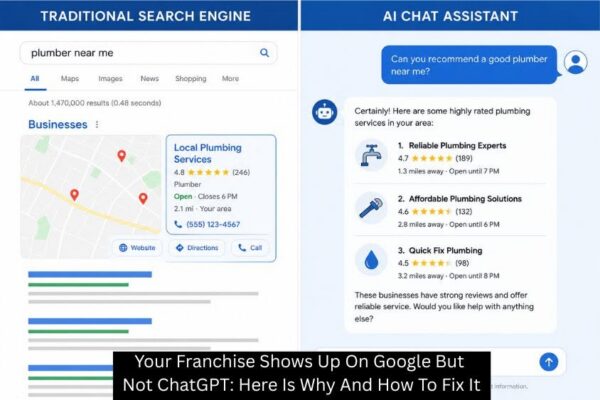
Only 1.2% of franchise locations currently appear in ChatGPT results, while 35.9% appear in Google’s Local Pack, according to SOCi’s 2026 data. That gap will close as AI search tools improve their access to structured local business data. The franchise locations that are already well-represented in Google’s local results have the best foundation for appearing in AI results as those systems mature.
The franchise brands that will gain the most from AI search are not building separate strategies for Google, ChatGPT, and Perplexity. They are building accurate, detailed, specific location data and letting it flow into every system that needs it. A location page with original content, real photos, complete schema, consistent citations, and genuine review volume is an AI-ready page. The work is not different from what strong local SEO has always required. The urgency is higher, and the window for building that foundation before AI search reaches full scale is narrowing.
Where To Start When Resources Are Limited
Not every franchise brand has the resources to rebuild 200 location pages, audit citations across 30 directories, and launch a review generation program simultaneously. For brands working with limited time or budget, the prioritization is important.
Start with NAP consistency. Incorrect or inconsistent name, address, and phone number data actively suppresses rankings and undermines every other signal. Audit the Google Business Profiles first, then the five highest-authority directories. Correct errors before investing in content or reviews.
Once NAP is clean, invest in location page content for the ten to twenty highest-revenue locations before expanding improvements across the full network. Prioritizing by market revenue ensures that SEO investment is aligned with the locations where ranking improvement produces the most measurable return.
Review velocity work can begin at the same time as the content phase, since it requires operational behavior change at the franchisee level rather than significant technical resources. Getting franchisees into the habit of requesting reviews consistently is a process that takes time to build, so starting it early pays dividends as content and citation improvements take effect.
Book A Free Franchise SEO Audit
ClickTecs has worked with franchise systems across North America for 25 years, managing multi-location SEO programs at every scale from emerging brands to networks with hundreds of locations. If your brand is ready to understand exactly where each location stands and what it would take to close the gap against local competitors, the first step is a free franchise SEO audit at https://clicktecs.net/contact/. The audit covers location page quality, GBP completeness, citation consistency, and review performance across a representative sample of your network.
Frequently Asked Questions
Does Every Franchise Location Need Its Own Dedicated Page On The Website?
Yes, every physical location or service-area market should have its own dedicated page. A single “Locations” page listing addresses and phone numbers does not rank in local search results. Individual location pages with original content, correct structured data, and locally specific information are the pages that Google connects to searches performed in those specific markets. For a franchise with 80 locations, that means 80 location pages, each built with content that is specific to that market and cannot be found in identical form on any other page of the site. Shared templates that differ only in city name do not meet this standard and will underperform against competitors who have invested in genuine local content.
How Long Does It Take To See Results From Multi-location SEO Improvements?
NAP corrections typically begin influencing local rankings within four to eight weeks as Google re-crawls updated listings and third-party directories. Location page content improvements take longer, often three to six months before meaningful ranking changes appear, because Google needs time to re-evaluate each page and gather new behavioral signals from searchers. Review velocity improvements can produce faster results in Google Maps specifically, since the Local Pack updates more frequently than organic results. Franchise brands should plan for a six-to-twelve month horizon when evaluating the return on a full multi-location SEO program, and should set intermediate benchmarks based on citation accuracy, GBP completeness scores, and review volume rather than waiting for ranking data alone.
Should Franchise Brands Manage SEO Centrally Or Let Individual Franchisees Handle Their Own Markets?
The data strongly favors centralized management or a structured hybrid approach. When franchisees manage their own SEO independently, consistency breaks down in predictable ways. NAP formats diverge across directories. Google Business Profile listings go unclaimed or accumulate outdated information. Review response quality varies from location to location. Some markets receive strong attention and others receive none. According to SOCi’s 2026 research, centrally managed franchise networks grew up to 74% faster in local search visibility than fragmented networks. The most effective model for most systems is centralized management of technical infrastructure, citations, and GBP listings, with franchisee input on local content details and review outreach. This structure keeps brand signals consistent while preserving the local knowledge that makes individual location content credible and useful.
What Is The Right Way To Ask Customers For Google Reviews Without Violating Google’s Policies?
Google’s policies prohibit offering incentives for reviews, asking customers to leave only positive reviews, or creating review stations in a business location where customers use the business’s own devices to submit feedback. What is permitted is sending a direct, neutral review request to customers after a transaction through a communication channel they have opted into. A text message containing a direct link to the Google review form, sent within 24 hours of service completion, is both compliant and effective. The message should invite honest feedback rather than directing customers toward a positive response. Franchisees should send review requests to every customer, not only those they believe had a positive experience. Selective outreach based on anticipated sentiment is a policy violation and also produces an artificially skewed review profile that does not reflect the location’s actual performance.
How Does Multi-location SEO Connect To Visibility In AI Tools Like ChatGPT?
AI-powered search tools draw on structured data, review signals, citation consistency, and content quality when generating local recommendations. These are the same signals that drive Google local rankings. A franchise location with complete LocalBusiness schema, consistent NAP data across directories, genuine review volume, and specific location page content is more likely to appear in both Google’s Local Pack and AI-generated answers than a location without those signals. The SEO work does not need to be rebuilt for AI search. It needs to be done correctly for Google, and the AI visibility follows from the same foundation. Currently only 1.2% of franchise locations appear in ChatGPT results compared to 35.9% in Google’s Local Pack, according to SOCi’s 2026 data. Brands that build strong local signals now are best positioned as that gap closes.
How Should A Franchise Brand Prioritize Multi-location SEO When Budget Is Limited?
The correct sequence for limited-resource situations is: NAP consistency first, location page content second, and review velocity third. Incorrect or inconsistent name, address, and phone number data actively suppresses rankings and undermines every other investment, so fixing it first is not optional. Once NAP is clean across Google Business Profile and the major directories, invest in improving location page content for the highest-revenue markets before expanding improvements to the full network. Review velocity work can begin during the content phase since it requires franchisee behavior change rather than significant technical budget. Prioritizing markets by revenue ensures that each dollar of SEO investment is allocated to locations where ranking improvement produces the greatest measurable business result.
CEO & Founder, ClickTecs
Jamshaid (Jam) Hashmi is a serial entrepreneur and franchise digital marketing expert with 25+ years of experience. As CEO & Founder of ClickTecs - North America's leading franchise digital marketing agency - Jam has helped 100+ franchise brands across Canada and the United States grow through SEO, PPC, social media, and AI Search strategies. Previously VP of Development at WSI, where he placed 400+ franchisees, he also co-founded FranchiseSoft, a SaaS franchise management platform. Jam sits on the Marketing & Innovation Committee of the IFA and the Canadian Franchise Association (CFA), and is a sought-after speaker on SEO, franchise lead generation, AEO, and AI for franchising.
Franchise Digital Marketing
Multi-Location SEO
Google Ads PPC
Meta Ads
View Full Profile →