Google Business Profile is where most local customers form their first impression of your franchise. Not your website. Not your social media pages. Not your paid advertising campaigns. When someone searches for a service near them and Google returns a local pack result, the information your potential customer sees in that moment comes directly from your Google Business Profile listing. What they find in that first glance determines whether they call, get directions, or click through, or whether they move on to a competitor whose listing gave them more confidence.
The numbers from 2025 make the stakes clear. Actions taken directly from Google Business Profile listings, including phone calls, direction requests, and website clicks, grew by 41% year over year in 2025, according to Google. That figure represents a significant shift in how customers interact with local businesses before ever visiting in person. The second number matters equally for franchise operators: businesses with complete Google Business Profiles are 70% more likely to attract location visits than those with incomplete or neglected listings, also according to Google research.
For a franchise network with 50, 100, or 200 or more locations, that 70% gap between a complete profile and an incomplete one is not a minor detail. It multiplies across every location in your system, every day, translating directly into customer decisions and revenue. If even a quarter of your locations are operating with outdated information, missing photos, or unanswered reviews, the cumulative cost is significant and largely invisible until someone runs an audit.
This guide covers what it takes to build, manage, and maintain Google Business Profiles at franchise scale so that every location in your network performs as well as it possibly can.
Why Google Business Profile Is More Difficult For Franchise Systems
Managing a single Google Business Profile requires care and attention. Managing a hundred of them, or several hundred, accurately and consistently across a distributed network is a fundamentally different problem that requires a different kind of system.
Every franchise location requires its own individual profile. Each one must reflect information that is specific and accurate for that location, including its address, phone number, hours, service offerings, and photos. When anything changes at a location, whether that is a phone number update, a seasonal hour adjustment, a new category of service, or even a physical move, the profile must be updated promptly. When an error occurs at the brand level and gets replicated across the network, it does not affect one location. It affects every location where that error has been pushed.
Franchisees managing their own profiles without centralized oversight introduce a different category of risk. Inconsistent business names that do not match signage, addresses entered in different formats, duplicate listings created during setup, and reviews sitting unanswered for weeks are common outcomes when profile management is left entirely to individual operators. These problems accumulate gradually and begin affecting local search rankings before anyone notices.
The solution requires a centralized management structure, clear brand standards for every field in every profile, and the right tools to maintain consistency at scale.
Bulk Verification And Central Account Management
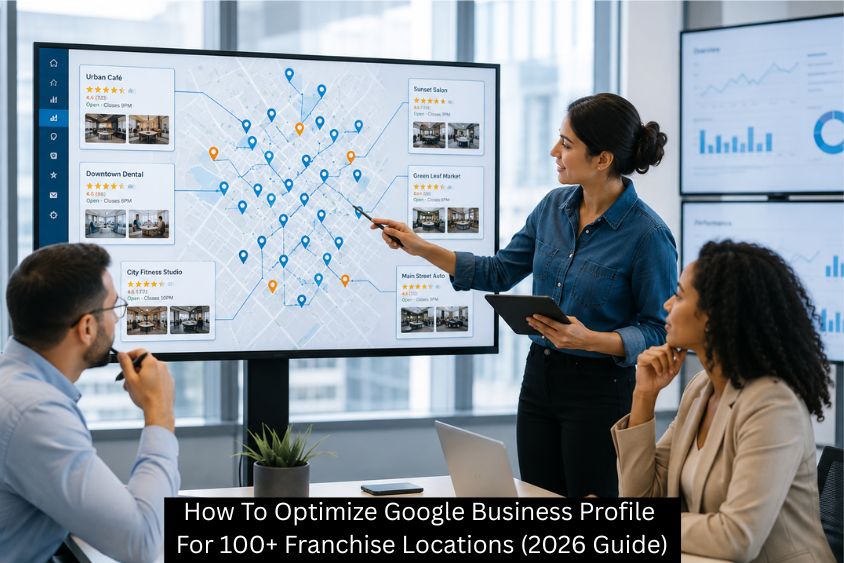
Google provides a multi-location management path through Google Business Profile Manager, and any franchise system with ten or more locations should be using it. The franchisor should own and maintain a verified business group that contains all franchise location profiles, managed from a single corporate account with the appropriate access levels in place.
This structure allows the corporate marketing team to push updates across many locations simultaneously, monitor profile health from a single dashboard, and maintain brand consistency without depending on individual franchisees to independently make the correct decisions across dozens of profile fields. Franchisees can be granted limited access to manage day-to-day updates relevant to their location without the ability to modify core brand information or business names.
Bulk verification through Google’s business group process is faster than verifying locations individually, and it reduces the risk of franchisees creating conflicting or duplicate profiles during the setup phase. If your network already has locations verified under different accounts, consolidating them into a single business group is the right first step before any other optimization work begins. The consolidation process requires coordination with Google’s support team, but the operational benefit of having all locations under centralized control is worth the effort.
The Profile Completeness Checklist Every Location Needs
Google rewards complete profiles, and the 70% increase in location visits for complete profiles is a direct reflection of how the algorithm treats completeness signals. Every field that sits empty is a missed ranking and visibility opportunity. Work through the following checklist for every location in your network.
**Business name:** The name must match store signage exactly. Do not add city names, keywords, or taglines to the business name field. Google’s guidelines explicitly prohibit this practice, and violations can result in profile suspensions that remove locations from Maps and search results entirely.
**Address:** Verify the address against your internal records and the corresponding website location page. A mismatch between the address in your Google Business Profile and the address on your website contact page is a consistency signal that affects local search ranking.
**Phone number:** Use a local phone number where possible. The number must be the direct line for that specific location, not a corporate call center line that routes through to multiple locations.
**Website URL:** Point the website field to the location-specific page on your website, not the corporate homepage. A customer clicking through from your profile should land on a page that immediately confirms their specific location, its hours, its address, and its services. Sending that customer to the homepage forces them to search again, and many will not bother.
**Primary and secondary categories:** The primary category carries the most weight as a ranking signal in local search. Choose it based on what the majority of your customers are searching for when they look for businesses like yours. Secondary categories can capture additional service types that are relevant but not the core offering.
**Hours:** Keep hours current at all times. Add holiday hours in advance, before the relevant period arrives. Incorrect hours are among the most common complaints customers leave in negative reviews, and they directly reduce trust in the listing before the customer has even made contact.
**Attributes:** Google offers attributes specific to each business category, covering accessibility features, payment options, service modes, amenities, and other details. Complete every attribute that applies to each location.
**Description:** Each profile allows a 750-character business description. Write a version that is specific to each location, referencing the neighborhood or area it serves, the services available at that particular site, and any details that distinguish it from other locations in the network. Using the same generic corporate description across every location in a large network misses the opportunity to create locally relevant content that both customers and Google’s algorithm respond to.
**Products and services:** Add your full product or service catalog to each profile. This content is indexed by Google and appears in search results for relevant queries, extending the visibility of the profile beyond branded searches.
Photo Strategy Across A Large Location Network
Photos drive engagement on Google Business Profile in a way that text fields alone do not. A profile with a complete photo library outperforms a profile with one or two token images at both the engagement and ranking levels.
Set a minimum standard of ten photos per location. That library should cover exterior shots of the physical building from the street, interior shots showing the customer environment, staff photos that give the business a human face, and product or service images that reflect what customers will experience when they visit. Update photos at minimum once per quarter. Seasonal content, new service additions, facility renovations, and other material changes should be documented with fresh photos when they occur.
Before uploading photos, use descriptive file names that reflect the content of the image. A file named “downtown-storefront-exterior-spring.jpg” provides more context than “IMG_4892.jpg,” and descriptive naming contributes to image relevance in local search in a way that generic camera-generated file names do not.
GBP Posts: Keeping Every Location Active And Current
Google Business Profile posts appear directly in the local knowledge panel and on Google Maps. They are free to publish, visible to anyone searching for the location, and consistently underused by franchise systems that are managing high location volumes without a scalable content process.
Each location should publish a minimum of two posts per month. Posts can cover current offers, upcoming events, new products or services, seasonal promotions, or business updates that customers in that market would find relevant. Posts expire after six months for general updates, meaning older content simply disappears if it is not renewed. Set a renewal calendar so that evergreen content does not lapse without being replaced.
A franchise system with 100 locations publishing two posts per month is producing 200 pieces of local content every month. That volume requires either a centralized content production and scheduling process or a template system that allows franchisees to publish brand-approved posts without writing them independently from scratch. Both approaches work, but neither works without a system behind it.
Q&A Management: Proactive And Responsive
The Q&A section of Google Business Profile is publicly visible and publicly writable. Anyone can submit a question, and anyone can submit an answer. Left unmanaged, this section fills with unanswered questions, incorrect answers submitted by well-meaning customers, and occasionally spam content that reflects poorly on the brand.
The right approach is to proactively seed the Q&A section for each location with eight to ten questions and accurate answers covering the most common things customers ask before they visit. Parking availability, appointment requirements, accepted payment methods, accessibility features, service availability, and location-specific details are all relevant candidates. Proactively seeding this section means customers find accurate answers immediately rather than encountering unanswered questions that signal the profile is not actively managed.
Monitor user-submitted questions across all locations and respond within 24 hours. A question that sits unanswered for several weeks communicates something about how the business treats customer inquiries, and that signal reaches prospective customers who are still deciding whether to visit.
Review Management At Scale
Reviews are a direct ranking signal in local search, and they are among the most visible elements of any Google Business Profile listing. Every review across every location deserves a response, and that applies with equal weight to positive reviews and negative ones.
A positive review response does not need to be long, but it should be specific enough to feel genuine rather than automated. Acknowledging a detail the customer mentioned in their review conveys care and attention in a way that a generic thank-you message does not.
Negative review responses require more care because they are public and will be read by future customers who are evaluating whether to trust the business. Acknowledge the customer’s experience without being defensive or dismissive, offer a clear path to resolution, and provide a direct contact method so the customer can follow up privately. Do not argue with the content of the review in the public response. Prospective customers who read the exchange will draw their own conclusions about how the business handles problems, and a composed, helpful response to a critical review builds more trust than the absence of any response at all.
Response rate and response speed are local ranking signals. A franchise network that responds to a high percentage of reviews promptly will outperform competitors who respond inconsistently, all other factors being equal.
Common Mistakes That Hurt Franchise GBP Performance
Several mistakes appear repeatedly when auditing franchise GBP portfolios, and each one creates measurable visibility problems.
Suspended listings occur when profiles violate Google’s guidelines. The most common triggers in franchise systems are keyword-stuffed business names, incorrect address formats, service area configurations that are too broad for the actual area served, and profiles that appear to be duplicates of an existing listing. A suspended profile is completely invisible in local search until the violation is resolved through a formal appeal process.
Duplicate profiles for the same location are common in franchise systems where locations were set up independently by franchisees before a central management structure was established. Duplicate listings divide ranking authority and confuse customers who encounter both versions, sometimes with conflicting information.
The wrong primary category sends incorrect signals to Google about the nature of the business. A location using a broad parent category instead of the most specific applicable option will lose ground to competitors who are categorized more precisely.
Mismatched NAP data, meaning the business name, address, and phone number appearing differently between the Google Business Profile and the corresponding website location page, is a consistency issue that suppresses local rankings. It is particularly common in franchise systems where the franchisor controls the website and the franchisee controls the GBP, without a shared verification process.
An empty description field leaves indexable content space unused and signals to Google that the profile is not fully maintained.
The accuracy problem extends beyond GBP into the broader information ecosystem. A 2026 SOCi study found that 32% of franchise information appearing on AI platforms is wrong or outdated. That inaccuracy begins at the source level with neglected or incorrectly maintained profiles like Google Business Profile, and it spreads to every platform and AI system that pulls from those sources. The downstream effect on how AI-generated answers represent franchise brands in local search is a growing concern for systems that do not maintain their source data carefully.
Building A GBP Management System That Scales
Managing Google Business Profile across a franchise network of meaningful size requires a repeatable system, not periodic manual attention. The elements of that system include centralized account access through Google Business Profile Manager, a defined update process that captures changes at the location level and routes them through a central review before going live, a photo collection and upload schedule, a post content calendar, a review monitoring and response workflow with defined response time targets, and a monthly audit process that identifies new issues before they compound.
Franchise systems that leave GBP management to individual franchisees without this kind of structure will see quality drift across the network over time. The locations that perform well locally will tend to be the ones where a motivated individual franchisee happens to prioritize their profile. The majority will underperform relative to what the brand could achieve with a centralized approach.
ClickTecs works with franchise systems to audit, build, and manage Google Business Profiles at scale. If your network has locations with missing information, outdated content, unresolved review gaps, or profile accuracy issues, those problems are directly affecting how many customers find and choose your locations over competitors. To find out where your network stands today, request a free GBP audit at https://clicktecs.net/contact/.
Frequently Asked Questions
How Many Franchise Locations Can One Google Business Profile Account Manage?
Google Business Profile Manager supports business groups that can contain hundreds of individual location profiles under a single corporate account. There is no published hard cap that would affect typical franchise networks, and Google offers additional enterprise support for brands managing large location volumes. Any franchise system with ten or more locations is eligible for the bulk verification process through the business group structure, which allows centralized management of all profiles from a single account. This means the franchisor’s marketing team or agency partner can maintain full oversight of every location’s profile without requiring individual franchisees to manage their own access or make independent decisions about profile content.
What Happens When A Franchisee Creates Their Own Separate Google Business Profile?
When a franchisee creates an independent profile for a location that already exists in the corporate business group, it creates a duplicate listing that can divide ranking authority between two competing profiles and present customers with conflicting information. Google’s systems may merge or suppress one of the duplicates, but the resolution process is not immediate and can cause temporary visibility loss during the correction period. The best preventive measure is to establish the corporate business group and grant franchisees managed access to their own location profile before they attempt independent setup. For networks where this has already occurred, an audit and consolidation process is needed to identify and resolve duplicate listings.
How Often Should Franchise Location Profiles Be Updated?
At a minimum, every profile should be reviewed and refreshed once per month to catch any information that has changed, including hours, contact details, or service offerings. Holiday hours should be added to each profile at least two weeks before the relevant period begins so customers searching during that window find accurate information. Photos should be updated at minimum once per quarter. Posts should be published at a minimum rate of twice per month per location. Any time a material change occurs at a specific location, such as a phone number change, a physical move, a new service addition, or a temporary closure, that update should go live in the profile within 24 hours of the change taking effect at the location itself.
Does Responding To Google Reviews Actually Affect Local Search Rankings?
Yes, review response behavior is a signal that Google’s local search algorithm considers when ranking profiles in local pack and Maps results. Google has stated in its own product documentation that responding to reviews demonstrates that the business values customer feedback, and this is treated as a quality indicator. Beyond the direct algorithmic effect, review responses are read by prospective customers who are actively deciding whether to visit. A profile where the business owner responds thoughtfully and consistently to both positive and negative reviews builds substantially more trust with those prospective customers than a profile where reviews accumulate without any response. For franchise networks, the practical goal is a consistent response rate above 90% with an average response time under 48 hours across all locations.
Why Do Franchise Location Profiles Get Suspended By Google?
Google suspends business profiles that appear to violate its guidelines, and the most common causes in franchise systems are business names that include added keywords or location modifiers beyond the actual store name, addresses that do not match a verifiable physical location, service area settings that are configured too broadly, or profiles that Google flags as duplicates of existing verified listings. Suspensions can also follow periods of rapid editing where large numbers of changes are made in a short window. A suspended profile disappears entirely from Maps and local search results until the violation is corrected through a formal appeal, which can take several weeks. This is one of the strongest operational arguments for centralized management, because a single franchisee making a well-intentioned but guideline-violating change to their profile can cause an entire location to go dark until the issue is resolved.
What Is The Most Common Google Business Profile Mistake Franchise Systems Make?
The most widespread mistake across franchise networks is pointing every location profile’s website field to the corporate homepage instead of the individual location page. This error reduces the relevance signal between the profile and the corresponding web page, and it sends prospective customers who click through to a page where they must then search again to find their specific location’s information. The customer who clicked from a local search is already showing intent to visit a specific location, and landing them on a homepage that does not confirm their location introduces friction that many customers will not work through. Every location profile should link to a dedicated location page that includes that location’s address, phone number, hours, a map, and locally relevant content. This alignment between the profile and the landing page is a foundational element of local search performance for any franchise system.

CEO & Founder, ClickTecs
Jamshaid (Jam) Hashmi is a serial entrepreneur and franchise digital marketing expert with 25+ years of experience. As CEO & Founder of ClickTecs - North America's leading franchise digital marketing agency - Jam has helped 100+ franchise brands across Canada and the United States grow through SEO, PPC, social media, and AI Search strategies. Previously VP of Development at WSI, where he placed 400+ franchisees, he also co-founded FranchiseSoft, a SaaS franchise management platform. Jam sits on the Marketing & Innovation Committee of the IFA and the Canadian Franchise Association (CFA), and is a sought-after speaker on SEO, franchise lead generation, AEO, and AI for franchising.
Franchise Digital Marketing
Multi-Location SEO
Google Ads PPC
Meta Ads
View Full Profile →