Picture this scenario. A parent opens ChatGPT on their phone and types: “What is the best tutoring service near me in Mississauga?” ChatGPT responds with three suggestions. A well-known national tutoring franchise that sits in the second position on Google Maps for that exact query does not appear in the AI response at all. The parent books an appointment with a competitor. The franchise owner never knew the opportunity existed.
This is not a hypothetical situation invented for a blog post. This is happening to franchise brands across North America every single day, at a scale that most marketing departments have not yet started to measure. According to SOCi’s 2026 Franchise Benchmark Report, local business searches conducted through ChatGPT grew from just 6 percent of all local queries in January 2025 to 45 percent by January 2026. That is not gradual consumer adoption. That is a structural shift in how people find and choose local businesses, and it accelerated far faster than most industry observers anticipated.
The numbers that should be sitting in front of every franchise development officer and regional marketing director are unambiguous. Only 1.2 percent of franchise locations appear in ChatGPT results for relevant local queries, compared to 35.9 percent that appear in the Google Local Pack. Gartner projects that traditional search volume will drop by 25 percent by the end of 2026. The conclusion is unavoidable: franchise brands that are not visible on AI platforms are already losing customers they do not know they are losing.
Why Google Rankings Do Not Transfer To AI Visibility
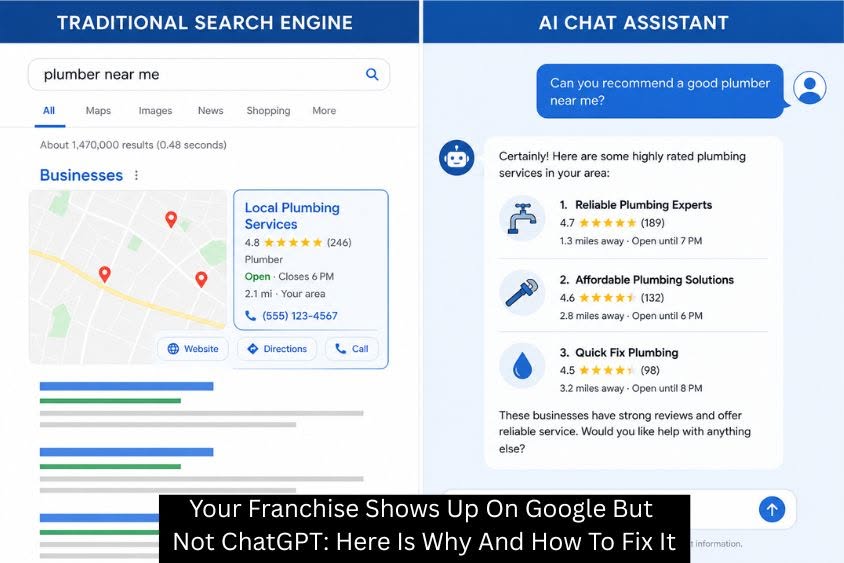
The first and most important thing to understand is that Google and ChatGPT are solving fundamentally different problems. This distinction is not technical trivia. It is the reason a franchise can rank on page one of Google and still be completely invisible on every major AI platform.
Google is a ranking engine. It evaluates hundreds of technical signals, including page speed, backlink authority, mobile performance, keyword relevance, and local signals such as Google Business Profile activity and review velocity, to determine which pages to surface for a given query. When you invest in Google SEO, you are optimizing for a live crawling and ranking system that can reward well-executed changes within a matter of weeks.
ChatGPT, Perplexity, and Google AI Overviews are synthesis engines. They do not rank pages against each other. They read content from across the web, evaluate which sources appear authoritative, consistent, and well-structured, and then generate a response that draws from those sources. A page that ranks exceptionally well on Google may still be entirely uncitable by an AI assistant if the content is thin, the business data is inconsistent across directories, or the page structure cannot be parsed by the AI systems that power these tools.
This distinction matters enormously for franchise brands. The typical franchise web presence was built to satisfy Google’s technical requirements and maintain brand consistency across dozens or hundreds of locations. It was never built to be cited by an AI that needs to distinguish between 80 nearly identical location pages, verify a business address against five different directories, and extract a meaningful answer from 150 words of marketing copy.
Five Reasons Franchise Brands Fail In AI Search
1. Duplicate Location Pages That AI Cannot Distinguish
Many franchise systems build their location pages from a single content template. The result is 50, 80, or sometimes more than 100 pages that are nearly identical except for the city name and address field. From Google’s perspective, these pages can still rank because Google evaluates each page individually against local relevance signals. From an AI assistant’s perspective, these pages are indistinguishable noise.
When ChatGPT or Perplexity encounters a set of near-identical pages, the AI cannot determine which location is relevant to a specific geographic query, cannot extract unique value from any individual page, and therefore skips the entire domain in favor of a source that offers clearer, more specific information about a particular place. Each location page needs to function as a genuinely distinct piece of content, with local area context, community-specific details, and unique service information that makes it useful to an AI trying to answer a question about that specific city or neighborhood.
A children’s education brand with 60 location pages, each containing the same three paragraphs with only the city name swapped, gives AI nothing to work with beyond a directory listing. That is not enough to earn a citation in a competitive local query.
2. Inconsistent NAP Data That Flags Your Business As Untrustworthy
NAP stands for Name, Address, and Phone Number. When your franchise location’s address appears one way on your website, a slightly different way on Google Business Profile, yet another variation on Yelp, and something else entirely on Bing Places, an AI assistant treats this inconsistency as a trust signal problem.
According to SOCi’s 2026 research, 32 percent of franchise business information appearing on AI platforms is wrong or outdated. Much of this problem originates from inconsistent NAP data that accumulates over years of location openings, address changes, phone number updates, and directory listings that nobody audited or corrected. A fitness franchise that has been operating for ten years in multiple markets has almost certainly accumulated significant NAP drift across the dozens of directories where its locations appear.
AI systems are designed to provide accurate information to users. When they detect conflicting data about a business across multiple sources, they are far more likely to skip that business in favor of a competitor whose information is clean, consistent, and verifiable. This means your NAP data is not just a citation signal. It is a fundamental trust signal that determines whether AI considers your business citable at all.
3. Thin Content That Gives AI Nothing To Quote
An AI assistant answering a local search query needs to find content worth citing. If your franchise location page contains 150 words of generic marketing copy, a phone number, and a contact form, the AI has nothing substantive to draw from. It cannot describe your services in useful detail, explain your process, address the questions real customers ask, or provide the kind of specific information that would make its response genuinely helpful to the person asking.
The standard franchise location page was designed for a world where Google rankings required keyword density and local signals, not genuine informational depth. AI search rewards genuine depth. A page that explains how your service works, describes what a customer can expect during their first visit, addresses common concerns, and provides context specific to the local market gives AI assistants the raw material they need to cite your business with confidence.
A home services franchise page that explains the specific process from initial consultation through project completion, mentions the neighborhoods it serves, addresses common questions about pricing and scheduling, and provides real information about the team at that location is a fundamentally different kind of content asset than a template page with a city name plugged in.
4. Missing Structured Data That AI Cannot Parse
LocalBusiness schema markup is a standardized way of telling search engines and AI systems exactly what your business is, where it is located, when it is open, and what services it offers. Without this structured data, an AI assistant must infer this information from unstructured text on your page, which introduces meaningful risk of errors, omissions, and the kind of data ambiguity that causes AI to lower its confidence in your business.
When your location pages include properly implemented LocalBusiness schema, you are providing AI systems with a reliable, machine-readable summary of the most important facts about each of your locations. This dramatically increases the probability that an AI will cite accurate information about your business and that it will successfully match your location to a geographically specific query.
The majority of franchise location pages we see during audits have no schema markup at all, or have partial implementation from a previous developer that was never completed or validated. This is one of the highest-impact technical gaps in franchise digital marketing today, and it is one that can be corrected systematically across a location portfolio.
5. No FAQ Schema To Signal What Questions You Answer
FAQ schema is one of the most underused tools in local franchise search optimization. When you mark up a set of questions and answers using FAQ schema on your location pages, you are explicitly communicating to AI systems: these are the questions our business answers, and here are the answers. This structured signal is the closest thing that exists to a direct line between your location page content and an AI assistant’s generated response.
A fitness franchise location that includes FAQ schema covering questions like “What types of classes do you offer?”, “Do you offer personal training?”, and “What are your membership options?” is far more likely to be cited when someone asks ChatGPT about fitness options in that neighborhood than a location page with no structured questions at all. FAQ schema converts your location page from a static information page into something that functions more like a question-answering document, which is exactly the kind of content AI assistants are built to surface.
The 32 Percent Wrong Information Problem
Even when AI does find your franchise, you may not want it to. SOCi’s 2026 research shows that 32 percent of franchise business information appearing on AI platforms is incorrect or outdated. This means that for roughly one in three franchise locations, an AI assistant is potentially directing customers to a wrong address, quoting a disconnected phone number, listing hours that changed two years ago, or describing services that location no longer offers.
A customer who follows AI-provided directions to a wrong address does not give your franchise brand a second chance. They leave a negative review, share the experience with friends and family, and choose a competitor whose information was accurate. The AI visibility challenge is not only about appearing in results. It is equally about appearing with correct, current, trustworthy information when you do appear.
This is why NAP cleanup and structured data implementation are not separate workstreams. They are part of the same foundational investment in making your franchise locations discoverable and trustworthy in an AI-driven search environment.
The Specific Fix For Each Of The Five Problems
**For duplicate location pages:** Invest in location-specific content development that goes beyond swapping the city name in a template. Each page should include genuine information about the local area, nearby landmarks or neighborhoods served, community involvement, staff introductions at that specific location, and any locally relevant programs or service variations. Aim for a minimum of 600 words of genuinely unique content per location page, built around the questions real customers in that market actually ask.
**For inconsistent NAP data:** Conduct a full citation audit across every major directory where your locations appear. Tools like BrightLocal or Yext can identify discrepancies across dozens of platforms simultaneously and flag the locations with the most severe inconsistency issues. Standardize your NAP format across every platform, including suite number formatting, phone number formatting, and exact business name usage, and establish an internal process for updating all listings whenever a location changes its address, phone number, or hours.
**For thin content:** Rebuild location pages around the real questions customers ask before they book. Interview franchisees about what people ask when they call or walk in. Survey recent customers about what they wanted to know before choosing your service. Build that research into the page as service descriptions, process explanations, staff bios, and community context that makes each location page genuinely useful to someone who has never visited that location.
**For missing structured data:** Implement LocalBusiness schema on every location page. Include the business name, full address, phone number, geographic coordinates, opening hours by day, price range indicator, and service catalog. Use Google’s Rich Results Test to validate each implementation before publishing, and build schema validation into your regular site maintenance process so new locations launch with correct schema from day one.
**For missing FAQ schema:** Identify five to ten questions that customers commonly ask about your service category and build a FAQ section on each location page that addresses those questions with specific, useful answers. Mark the FAQ section up with FAQ schema. Update the questions and answers regularly to reflect seasonal changes, new services, recent customer feedback, or common concerns that appear in your review responses.
How To Test Your AI Visibility Today
Testing your current AI visibility requires no specialized tools and takes less than 30 minutes. The gaps you identify in this process are the exact gaps that are costing your franchise real business right now.
**On ChatGPT:** Open a new conversation and type “What is the best [your service category] near me in [your city]?” Note whether your brand appears in the response, how it is described, and whether the address, phone number, and hours are accurate. Run this test for three or four of your strongest markets to identify how consistent your visibility is across geographies.
**On Perplexity:** Run the same queries on Perplexity.ai and examine which sources the AI cites in its response. If your website appears as a cited source, click through to verify the content Perplexity surfaced is current and accurate. If competitors appear and you do not, examine their location pages to understand what content signals they are providing that yours are not.
**On Google AI Overviews:** Search for your service category plus location in Google and look for the AI Overview panel that appears above the standard search results. Note whether your locations appear, what information Google surfaces, and whether any of that information is incorrect or outdated.
Document every finding across all three platforms. Record which locations appear, which do not, what information is cited, and where that information is wrong. This documentation becomes the brief for your remediation roadmap.
The Window To Act Is Open Right Now
The franchise brands that move first on AI visibility will carry a meaningful advantage that compounds over time. AI systems learn from the signals they receive, and a brand that consistently appears as a reliable, well-cited source across queries builds a pattern of authority that makes future citations more likely. The brands that wait until AI search is fully dominant will face a steeper and more expensive remediation effort.
The good news is that the fixes required are not technically exotic. They require disciplined execution across your location portfolio, consistent data management practices, and a content approach that prioritizes genuine usefulness over keyword-optimized templates. These are solvable problems for franchise systems that have the right digital marketing partner and the organizational commitment to execute across their full location network.
ClickTecs has worked with franchise brands for 25 years, and we have been tracking the AI visibility gap since it began accelerating in early 2025. We offer a free AI visibility audit for franchise systems that want a clear picture of where they stand across ChatGPT, Perplexity, and Google AI Overviews. Visit https://clicktecs.net/contact/ to request your audit and find out exactly which of your locations are visible, which are invisible, and what it will take to close the gap before your competitors do.
Frequently Asked Questions
Does Ranking Well On Google Mean My Franchise Will Also Appear In ChatGPT Results?
No. Google rankings and ChatGPT visibility are determined by completely different systems that evaluate different signals. Google uses technical performance metrics, backlink authority, and local relevance signals to rank individual pages in its results. ChatGPT and other AI assistants evaluate content authority, data consistency across the web, and structural clarity to decide which sources to cite in a generated response. A franchise location page can rank in the top three on Google and still be entirely absent from ChatGPT results if the content is thin, the NAP data is inconsistent across directories, or the page lacks LocalBusiness schema markup. Success in one system does not transfer to the other, and each requires its own optimization strategy. Franchise systems that treat AI visibility as an extension of their existing Google SEO program will find that assumption does not hold up in practice.
How Long Does It Take To Improve Franchise Visibility In ChatGPT After Making Fixes?
The timeline varies based on the scope of changes and the AI platforms in question. Structured data improvements such as adding Local Business and FAQ schema can begin to influence AI results within two to four weeks as AI crawlers re-index the updated pages. Content improvements take longer because AI systems need to accumulate enough signals across the web before treating a page as genuinely authoritative. NAP cleanup across directories typically shows meaningful improvement within 60 to 90 days, as the corrected information propagates across data aggregators and secondary directories. For franchise systems with large location portfolios, a phased rollout that prioritizes the highest-traffic markets and most inconsistent locations is generally the most practical approach to managing the workload without overwhelming the internal team.
What Is NAP Data And Why Does Inconsistency Prevent AI From Citing My Franchise?
NAP stands for Name, Address, and Phone Number, and these three pieces of information appear across dozens of directories, review platforms, mapping applications, and data aggregators that AI systems pull from when generating local search responses. When your franchise location data is inconsistent across these platforms, perhaps the suite number is missing on one listing, the phone number is outdated on another, or the business name is abbreviated differently on a third, AI systems treat this inconsistency as a trust problem. AI assistants are built to give users accurate information, so when they detect conflicting data about a business across multiple authoritative sources, they are more likely to skip that business entirely rather than risk citing incorrect details. For franchise networks with large location counts, NAP drift is almost inevitable without a systematic process for auditing and updating listings whenever any location detail changes.
What Is Local Business Schema And Why Does Every Franchise Location Page Need It?
Local Business schema is a standardized code markup drawn from the Schema.org vocabulary that tells search engines and AI systems exactly what type of business a page represents, along with the key details that define that business including its full address, phone number, hours of operation by day, geographic coordinates, and the services it offers. Every franchise location page intended to attract local customers should have Local Business schema implemented correctly and completely. Without it, AI systems must attempt to infer all of this information from the unstructured text on the page, which introduces meaningful risk of errors, gaps, and the kind of data ambiguity that reduces AI confidence in your business. With it, you are providing a clean, machine-readable summary that AI can parse reliably and cite with accuracy. It is one of the highest-impact technical fixes available for improving franchise AI visibility and it should be treated as a baseline requirement, not an optional enhancement.
How Do I Find Out If ChatGPT Is Showing Wrong Information About My Franchise Locations?
The most direct approach is to run manual tests for each of your key locations using ChatGPT, Perplexity, and Google AI Overviews. Search for your service category and each city where you operate, then compare what the AI reports against your actual current information for address, phone number, hours, and services offered. SOCi’s 2026 research found that 32 percent of franchise business information on AI platforms is wrong or outdated, which means the probability that at least some of your locations have inaccurate AI citations is very high. A network-wide audit that checks directory consistency, schema implementation, and content accuracy across every location will give you the complete picture. ClickTecs runs these audits for multi-location franchise clients and can identify exactly which locations have accuracy problems and what the source of those problems is in each case.
Is Optimizing For AI Search Different For Franchise Systems Than For Independent Local Businesses?
Yes, the challenge is significantly different in scale and complexity. An independent local business manages one location, one set of NAP data, and one page that needs unique content. A franchise system may have 50, 200, or more than 1,000 locations, each of which needs individually optimized content, individually verified directory listings, individually implemented schema markup, and ongoing maintenance to stay current as the business evolves. The template-based approaches that work well for brand consistency across a franchise network are exactly the approaches that create the problems AI systems penalize: duplicate content, thin pages, and indistinguishable location data that gives AI no basis for differentiation. Solving this at franchise scale requires systematic processes, the right technology tools, and a content strategy that balances brand consistency with the location-specific depth that AI rewards. It is a meaningfully different problem than what an individual business owner faces, and it requires a partner with experience managing digital marketing at multi-location scale.

CEO & Founder, ClickTecs
Jamshaid (Jam) Hashmi is a serial entrepreneur and franchise digital marketing expert with 25+ years of experience. As CEO & Founder of ClickTecs - North America's leading franchise digital marketing agency - Jam has helped 100+ franchise brands across Canada and the United States grow through SEO, PPC, social media, and AI Search strategies. Previously VP of Development at WSI, where he placed 400+ franchisees, he also co-founded FranchiseSoft, a SaaS franchise management platform. Jam sits on the Marketing & Innovation Committee of the IFA and the Canadian Franchise Association (CFA), and is a sought-after speaker on SEO, franchise lead generation, AEO, and AI for franchising.
Franchise Digital Marketing
Multi-Location SEO
Google Ads PPC
Meta Ads
View Full Profile →