
When a national children’s education franchise operating over 100 locations across North America first contacted ClickTecs, the gap between their offline reputation and their digital presence was striking. Parents in their communities knew the brand. Word of mouth had carried them far. But when families searched online, or asked an AI assistant for recommendations, the franchise was largely invisible. That gap was costing them leads every single day, in every single market.
This case study walks through exactly what we found, what we did, and what the numbers looked like at the end of six months.
What The Franchise Was Dealing With Before Engaging ClickTecs
Our first task with any franchise client is an honest audit. We do not sugarcoat findings, because the gaps we identify are the same gaps that are actively costing the business money. For this franchise, the audit produced a detailed picture of a brand that had grown quickly through franchisee expansion without a consistent digital infrastructure beneath it.
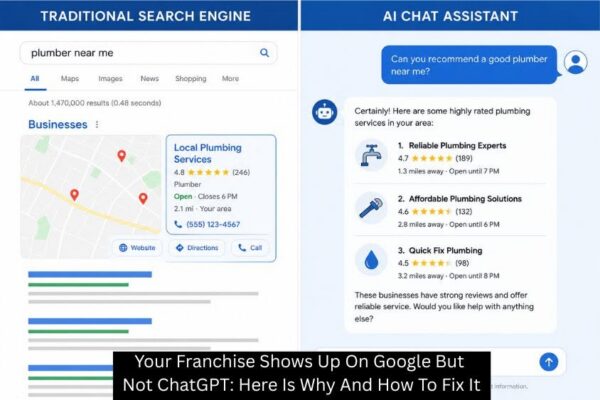
**AI visibility was effectively zero.** We tested the franchise against 20 priority cities using the major AI assistants that families use today, including ChatGPT and similar tools. In none of those 20 cities did the franchise appear as a recommended provider for children’s education services. This is increasingly significant, because a growing share of local service discovery now starts with a conversational AI query rather than a traditional Google search. Parents type questions like “What are the best children’s education programs near me?” and the AI draws on structured data, authoritative content, and review signals to generate its answer. The franchise had built none of that infrastructure.
**Listing inconsistencies were widespread.** Across the network of over 100 locations, 23% of locations had at least one NAP discrepancy, meaning the business name, address, or phone number listed on one directory did not match what was listed on another. Some locations were still showing addresses from relocations that had happened two or three years earlier. When Google and other platforms encounter conflicting signals about where a business is and what it is called, those conflicting signals erode local search rankings. The franchise was paying a ranking penalty it did not know existed.
**Location pages were identical in everything but the city name.** Every location page on the franchise website used the same template content, with only the city name and address swapped in. From a search engine’s perspective, this is near-duplicate content repeated over 100 times. None of the pages gave Google meaningful local signals. None of them answered the specific questions families in those markets were asking. Each page was a missed opportunity, and there were over 100 of them.
**Review velocity was extremely low.** Across the entire network, the franchise was generating an average of only eight new reviews per month total. Many individual locations had gone 60 days or longer without receiving a single new review. Reviews are a trust signal for both search engines and for parents doing research. A location with no recent reviews sends an uncertain message to a family weighing their options.
**Google Business Profile completeness was poor.** Across the network, 34% of profiles were missing photos entirely. Eighteen locations were showing incorrect operating hours. Categories were inconsistent. The Q&A section, which is an important content surface for both search and AI visibility, was unused. These are the details that determine whether a business profile looks trustworthy or looks abandoned.
The Six-Month Program ClickTecs Executed
We structured the engagement as a phased program, because the order of operations matters. There is no point building content on a broken data foundation. There is no point earning reviews for a profile that has the wrong hours. We fixed the foundation first, then built on it.
**Month 1: Listing Audit and Correction**
Our team conducted a full listing audit across Google, Apple Maps, Bing, Yelp, and Facebook for every location in the network. The audit identified 312 distinct listing errors, ranging from outdated addresses and wrong phone numbers to duplicate listings for the same location. We corrected all 312 errors and submitted updates through the appropriate channels for each platform. By the end of month one, the franchise had accurate, consistent NAP data across five major directories for the first time in years.
**Month 2: Google Business Profile Overhaul**
With listings corrected, we turned to GBP completeness. We updated every profile across all 100+ locations for accuracy and completeness. Each profile received location-specific photos, not stock images shared across the network. We built out the Q&A section for each profile with the questions families in that market were most likely to ask. We standardized categories across the network so that Google understood exactly what type of service each location was offering. This work alone produced early ranking improvements in several markets before any content work had begun.
**Month 3: Location Page Content Overhaul**
This was the most labor-intensive phase of the program. Every location page on the franchise website received a full content overhaul. Each page was rewritten with a minimum of 300 unique words that were genuinely specific to that location and market. We wrote local FAQs addressing the questions parents in those communities were actually searching. We embedded Google reviews directly into each page. We implemented Local Business schema markup on every location page so that search engines and AI systems could parse structured data about the business directly from the page itself. We replaced stock photography with real photos specific to each location where possible.
The goal was to give Google, and AI assistants, a reason to treat each location as a distinct, authoritative local presence rather than a replicated template with a different city name dropped in.
**Months 4 and 5: AEO Content and FAQ Schema**
With the location pages rebuilt, we focused on answer engine optimization. We implemented FAQ schema on every location page, targeting the specific questions families ask when researching children’s education options. We then published five authoritative long-form blog posts on the franchise website, each targeting a different category of question that families were directing to AI assistants. These posts were written to provide complete, structured answers that AI systems could cite and reference, not just keyword-targeted content for traditional search.
This is the content layer that drives AI visibility. AI assistants do not recommend businesses at random. They recommend businesses that have structured, trustworthy, locally specific content that answers the questions users are asking. We built that content for this franchise.
**Month 6: Review Velocity Program**
The final phase addressed review generation at scale. We designed a post-session review request workflow using both email and SMS, triggered automatically after a family completed a session. The workflow was built to be natural and low-friction, with personalized messaging that did not feel like a mass solicitation. We trained franchisee staff on how to mention the review request in person as well, because a warm in-person mention increases the likelihood that a family will follow through on the digital request.
The results of this phase were immediate and significant.
The Results After Six Months
By the end of the six-month engagement, the numbers across the franchise had shifted in ways that were meaningful at both the network level and at the individual location level.
**Inbound leads grew by 340%** compared to the same six-month period in the prior year. This was the headline metric the franchise cared about most, and it reflected the cumulative effect of every phase of the program working together.
**Website traffic increased by 128% year over year.** The rebuilt location pages and the new AEO content combined to drive significantly more organic sessions to the site, and those sessions converted at a meaningfully higher rate because the pages they landed on were locally relevant and trust-building.
**The franchise now appears in ChatGPT results in 14 of the top 20 priority cities.** At the start of the engagement, that number was zero. The AI visibility gains came directly from the FAQ schema, the structured content, and the review signals that gave AI systems reason to cite the franchise as a credible local provider.
**Monthly reviews per location increased from 8 to 47 network-wide.** The review velocity program turned review generation from an afterthought into a consistent, compounding process. Locations that had been dormant for 60 days now had a steady stream of fresh social proof appearing in their profiles every month.
**NAP discrepancies across the five primary directories dropped to zero.** The data foundation the franchise operates on is now clean, consistent, and maintained.
**Average Google Maps position in priority markets improved from 6.2 to 2.8.** In local search, the difference between position six and position two is not incremental. It is the difference between being found by most searchers and being found by almost none of them, because the map pack results that drive local clicks are dominated by the top three positions.
What Actually Drove The Results
Three decisions drove these outcomes, and franchises in any category can apply all three of them.
**Fixing the data foundation before doing anything else.** Every dollar spent on content, reviews, or advertising is less effective when the business’s basic information is inconsistent or wrong across directories. We spent the first month doing work that felt unglamorous but that paid compounding dividends across every subsequent phase. A clean data foundation is not optional, it is the prerequisite for everything else.
**Writing content that is genuinely locally specific, not template content with a city name dropped in.** Search engines and AI systems are sophisticated enough to distinguish between content that was written for a specific community and content that was duplicated across 100 pages. The investment in writing real local content for each location page was significant, but it produced ranking improvements and AI visibility gains that template content was never going to deliver.
**Building review velocity as a compounding advantage.** Reviews are not a campaign. They are a system. The franchise went from 8 reviews per month to 47 reviews per month not because we ran a one-time push, but because we built a workflow that generates reviews consistently as a natural byproduct of the service the franchise already delivers. Every new review makes the next location harder to unseat in local rankings.
Ready To See What These Results Could Look Like For Your Franchise?
ClickTecs works exclusively with franchise brands across North America. If your franchise has a gap between its offline reputation and its digital performance, we want to show you exactly where that gap is and what it would take to close it.
Request your free franchise digital marketing audit at ** https://clicktecs.net/contact/**. We will review your listings, your location pages, your review velocity, and your AI visibility, and we will give you a clear, honest picture of where the opportunities are.
Frequently Asked Questions
How Long Does It Typically Take To See Results From A Franchise Digital Marketing Program?
The timeline depends on which problems are being addressed and how severe the baseline issues are. In our experience working with franchise networks, the first meaningful improvements in Google Maps rankings and website traffic typically appear within 60 to 90 days of correcting listing errors and improving Google Business Profile completeness. Larger gains, including the type of 340% inbound lead growth described in this case study, reflect six months of compounding work across listings, content, and review velocity. AI visibility gains tend to appear between months four and six, once structured content and FAQ schema have been indexed and evaluated by AI systems. Franchise brands that expect overnight results from digital marketing programs often underestimate how much foundational correction is required before the promotional work can deliver returns.
Why Does NAP Consistency Matter So Much For Franchise Local SEO?
NAP stands for name, address, and phone number, and it is the core identity signal that search engines use to verify that a business is real, trusted, and accurately represented across the web. When a franchise location has different address information on Google than it does on Yelp or Apple Maps, search engines register that inconsistency as a signal of unreliability. The result is a suppressed local ranking, sometimes significant, even when all other factors look healthy. For franchise networks with 50, 100, or 200 locations, NAP inconsistencies multiply because locations relocate, phone numbers change, and directory updates do not propagate automatically. A network-wide listing audit and correction program is the fastest way to recover the ranking equity that inconsistent data is actively suppressing.
What Is AEO, And Why Does It Matter For Franchise Brands Right Now?
AEO stands for answer engine optimization, and it refers to the practice of structuring content so that AI assistants, including ChatGPT, Gemini, and Perplexity, can use that content to answer user questions directly. Traditional SEO focused on ranking in Google’s blue link results. AEO focuses on being the source that an AI assistant cites or recommends when a user asks a conversational question. For franchise brands, this matters because a growing share of local service discovery now starts with an AI query rather than a traditional search. Families asking “What are the best children’s education programs near me?” are increasingly getting answers from AI, not from a search results page. Franchise brands that do not have structured, FAQ-schema-marked content on their location pages and website are invisible to those AI recommendations, regardless of how well they rank in traditional search.
How Does Review Velocity Affect Franchise Local Search Rankings?
Review velocity, meaning the rate at which a business generates new reviews over time, is a significant ranking factor in Google’s local algorithm. A location that generates 40 new reviews per month sends a stronger signal of active, trusted business activity than a location that received 40 reviews in total over the past two years. For franchise networks, review velocity is a compounding advantage: locations that generate consistent reviews build ranking momentum that makes them progressively harder for competitors to displace. The most effective way to build review velocity at scale is not to run periodic review campaigns, but to build a post-service workflow that requests reviews automatically and consistently as part of normal operations. ClickTecs designs these workflows to be natural and brand-appropriate rather than intrusive.
Can Franchise Location Pages Rank Well In Local Search If They All Cover The Same Service Category?
Yes, but only if the content on each page is genuinely locally specific. Location pages that use template content with only a city name and address changed are treated as near-duplicate content by search engines, which means they compete against each other and collectively underperform. Location pages that contain unique, locally relevant content, including local FAQs, references to the community, embedded reviews from local customers, and structured schema markup, are treated as distinct pages and can rank independently in their respective markets. The franchise in this case study had over 100 location pages using identical template content. After rewriting each page with 300 or more unique words of locally specific content, the network saw substantial ranking improvements across priority markets within 90 days.
What Does A Franchise Digital Marketing Audit From ClickTecs Cover?
A ClickTecs franchise audit covers the five areas that most directly affect inbound lead volume for multi-location brands. First, we audit NAP consistency across the five primary directories for every location in your network. Second, we evaluate Google Business Profile completeness and accuracy for each location, including photos, hours, categories, and Q&A content. Third, we assess location page content quality and identify template or near-duplicate content issues. Fourth, we measure your current AI visibility by testing your brand against your top priority cities in major AI assistants. Fifth, we review review velocity data across your network to identify locations that are underperforming on social proof generation. The audit is provided at no cost, and it gives you a clear, prioritized picture of where your franchise network is losing leads and what it would take to recover them.
CEO & Founder, ClickTecs
Jamshaid (Jam) Hashmi is a serial entrepreneur and franchise digital marketing expert with 25+ years of experience. As CEO & Founder of ClickTecs - North America's leading franchise digital marketing agency - Jam has helped 100+ franchise brands across Canada and the United States grow through SEO, PPC, social media, and AI Search strategies. Previously VP of Development at WSI, where he placed 400+ franchisees, he also co-founded FranchiseSoft, a SaaS franchise management platform. Jam sits on the Marketing & Innovation Committee of the IFA and the Canadian Franchise Association (CFA), and is a sought-after speaker on SEO, franchise lead generation, AEO, and AI for franchising.
Franchise Digital Marketing
Multi-Location SEO
Google Ads PPC
Meta Ads
View Full Profile →