According to Franchise Business Review, 88% of franchise brands will use at least one AI marketing tool by the end of 2026. That number sounds like momentum. What it does not tell you is how many of those brands are actually getting results worth the investment.
Using AI tools and using them well are two entirely different things. At ClickTecs, we have spent 25 years working with franchise systems across North America, and we have seen both sides of this story in the past two years alone. We have seen franchise brands automate content publishing and end up with location pages that mention a city name repeatedly without saying a single thing that would resonate with someone who actually lives there. We have seen AI chatbots confidently give qualified leads wrong information about service territories and investment minimums. We have seen AI-powered advertising optimization burn significant budget because the campaign never generated enough conversion volume for automated bidding to function the way the platform intended.
None of that means AI tools are useless. It means they work when you match the right tool to the right problem, and when a knowledgeable person remains involved in the process. This guide covers five categories of AI marketing tools that are active in the franchise space right now, with an honest account of where each one delivers real value and where each one tends to fall short.
Category 1: Content Generation Tools
Content generation tools are the most widely adopted category in franchise marketing, and the adoption rate makes sense. When a franchise system needs to produce first drafts of FAQ pages, email nurture sequences, service page descriptions, or blog content across dozens of locations, the writing volume can easily overwhelm a small marketing team.
These tools perform well when the output is treated as a starting point rather than a finished product. A human editor who knows the brand voice, the audience, and the local market still needs to review every piece before it goes live. When that review step is built into the workflow, content generation tools can meaningfully reduce the time it takes to get a first draft ready for editing.
Where content generation tools fall short is in producing locally specific content. AI-generated location pages tend to follow a recognizable pattern. They mention the city name frequently, list services in general terms, and use phrases that could describe any location in any market. What they rarely do is say anything that would read as credible to someone who actually lives in that neighborhood or city. A paragraph that could apply to any location is not local content. It is templated content with a city name inserted, and search engines are increasingly capable of identifying that distinction.
Franchise marketing teams that benefit most from content generation tools are those with the editorial capacity to catch and correct this problem before content is published. The quality issues in AI-generated content are real and consistent. They require active editing to fix, not just a quick proofread before the post goes live.
Watch specifically for hollow filler language in published output. Phrases that sound polished but carry no specific meaning are a signature quality problem in AI-generated drafts. Editors need to look for this pattern deliberately.
Category 2: Lead Qualification Chatbots
Franchise systems manage two distinct inquiry types that require very different responses. A potential customer looking for services and a potential franchisee exploring ownership need entirely different conversations. Managing both at high volume, and doing it well outside business hours, is a genuine operational challenge for brands that do not have a 24-hour response team in place.
Lead qualification chatbots handle initial inquiry routing reasonably well. They can answer first-level questions, collect contact information, ask the qualifying questions that separate customer leads from franchise development leads, and direct each inquiry to the appropriate team or follow-up sequence. For franchise brands that cannot staff a full-time phone response operation, this capability addresses a real gap.
The category runs into trouble when questions require nuanced or location-specific knowledge. A chatbot trained on static brand information cannot answer questions that depend on real-time data about a specific territory or location. Questions about whether a particular service area is currently available, what the current investment range looks like, or whether a specific location offers a specific service require either live human involvement or a knowledge base that is updated every time anything changes at the brand level.
The failure mode we see most often is a chatbot that was configured with brand information from a year or more ago, confidently providing qualified leads with answers that are no longer accurate. A prospective franchisee who receives wrong information about territory availability or investment requirements early in the inquiry process is a lead that may disengage before the conversation can be corrected.
Any franchise brand using a lead qualification chatbot should audit the information it delivers at minimum every quarter, and immediately after any significant brand-level change.
Category 3: Google Business Profile Management And Listing Tools
For franchise systems operating more than 25 locations, managing Google Business Profiles manually is not a realistic use of team capacity. Listing management platforms built for multi-location brands solve a genuine problem by allowing bulk updates across the entire network simultaneously and monitoring profiles for unauthorized changes.
Third-party edits to Google Business Profiles are a persistent problem for franchise brands. A listing gets flagged as permanently closed by a user who had a bad experience. A phone number gets changed to an incorrect number without the brand’s knowledge. A service category gets removed or modified. Listing management tools can detect these changes and alert the team when they occur, and in some cases push corrections automatically, which at scale would otherwise require dedicated staff hours every week.
Where these tools lose accuracy is in catching subtler errors. A franchisee’s phone number changes because a location relocated, but the update comes through an authorized channel so no alert fires. A profile gets suppressed by a duplicate listing that exists nearby, and the suppression does not trigger a visible notification in the platform. These edge cases require human attention to catch.
The reliable approach is to use listing management tools for what they do well, which is the speed and scale of bulk updates across large location networks, while maintaining a manual quarterly review process where a person checks each location’s profile individually for accuracy. The tools reduce the labor required significantly. They do not eliminate the need for human review entirely.
Category 4: AI-Powered Paid Advertising
Automated bidding in paid advertising platforms uses machine learning to adjust bids in real time based on signals including device type, user location, time of day, audience history, and predicted conversion likelihood. When the conditions are right, automated bidding outperforms manual bidding because it responds to patterns that no human analyst can process at that speed or scale.
The condition that matters most is conversion volume. Automated bidding needs a meaningful volume of conversion data to learn from before it can make reliable decisions. A campaign generating 30 or more conversions per month per campaign has enough signal for the algorithm to function the way it was designed. A franchise location generating three to five leads per month does not produce that signal, and in a low-volume environment, automated bidding often makes erratic decisions because it is essentially working with insufficient data.
Ad copy variation testing is another area where AI tools in paid advertising deliver genuine value for franchise systems. Testing multiple headline and description combinations across a campaign at the scale required to reach statistical significance is not practical to manage manually across many locations. Automated testing handles this well and consistently.
The failure mode that costs franchise brands real budget is activating automated bidding before conversion tracking is properly configured. If the tracking setup is recording incorrect conversion events, or missing conversion events entirely, the algorithm optimizes toward the wrong behavior. The automation does not correct for bad inputs. It amplifies the problem.
Before activating any AI bidding strategy, verify that conversion tracking is accurately recording the events that actually represent business value for your specific type of franchise, whether that is a form submission, a phone call that meets a minimum duration threshold, a booking, or a direction request from a local listing.
Category 5: Reporting And Analytics Dashboards
Multi-location franchise marketing creates a data management problem that is difficult to handle manually. Performance data from 50 or 100 or 200 locations, spread across paid advertising, organic search, local listings, and website analytics, produces more information than any marketing team can reasonably review on a consistent weekly basis.
AI-powered reporting dashboards consolidate this data into a single view and, when built well, surface the locations that are performing dramatically above or below the network average. This makes it possible for a franchise marketing director to identify which markets need attention and which are producing results worth studying and replicating across the system. That kind of network-wide visibility used to require a dedicated business intelligence team. Now it is accessible to marketing directors who invest in the right tooling.
What these dashboards cannot do is explain why something changed, or separate correlation from causation in the data they present. A dashboard showing that a particular location saw a 40% decline in organic search visibility last month tells you something happened. It does not tell you whether a competitor opened nearby, whether the location’s Google Business Profile was incorrectly edited, whether the website had a technical issue, or whether a local event temporarily shifted search patterns in that market. That diagnostic work requires a person who understands the channel and knows the market.
A practical caution for franchise systems building or expanding their reporting dashboards: more metrics do not automatically produce better insight. A dashboard tracking 30 metrics across 150 locations creates data overload that tends to result in nobody reading the reports carefully or acting on what they show. Limit the core dashboard to five to seven metrics that directly inform marketing decisions, and treat everything else as data available on request when a specific question needs answering.
Four Questions To Ask Before Investing In Any AI Marketing Tool
Before committing budget or operational capacity to any AI marketing tool for your franchise system, work through these four questions.
First, what specific problem is this tool solving, and is that problem actually present in your system right now? Many AI marketing tools solve real problems, but for brands at a different scale or stage than yours. A listing management platform built for a 200-location system may be overbuilt and overpriced for a system with 15 locations.
Second, what is the minimum human involvement required to get acceptable results from this tool? Every AI marketing tool in the categories covered here requires ongoing human oversight. If the vendor’s pitch implies the tool runs itself without meaningful human involvement, that is a claim worth examining carefully before signing a contract.
Third, do you have the data volume, content volume, or editorial capacity this tool needs to function well? Automated bidding requires conversion volume. Content generation tools require editorial capacity to catch quality problems. Listing management tools require an accurate master data source to push updates from. The tool performs only as well as the inputs it receives.
Fourth, how will you measure whether this tool is working, and what will you do if it is not performing to expectations after 90 days? Define success criteria before you start, not after two months of ambiguous results.
Talk To A Franchise Marketing Specialist
ClickTecs has spent 25 years helping franchise systems grow through digital marketing built for the specific realities of multi-location brand management. We work with franchise systems across food service, home services, health and wellness, and professional services, from single-digit location systems building their digital presence for the first time to networks of more than 200 locations running complex multi-market campaigns.
If you are evaluating AI tools for your franchise network, or looking for a clearer picture of where your current marketing program is and is not working, we are glad to have that conversation. Visit https://clicktecs.net/contact/ to schedule a free consultation with our team.
Frequently Asked Questions
Are AI Marketing Tools Worth The Cost For Smaller Franchise Systems With Fewer Than 15 Locations?
The value of AI marketing tools scales with the number of locations you operate and the volume of content or data those locations generate. For a franchise system with fewer than 15 locations, some tools in this category, particularly listing management platforms built for enterprise-scale networks and multi-location reporting dashboards with high monthly licensing fees, may cost more than the time they save at your current size. Content generation tools can offer value at any system size, provided the team has the editorial capacity to review output before it is published. The most practical approach for smaller systems is to evaluate each tool category against the specific time or cost problem it would solve in your operation, rather than adopting tools because the broader industry is moving toward AI adoption. Your marketing budget is finite, and the tool that delivers real return on investment at your scale is not always the same tool that works well for a 200-location system.
How Do We Prevent AI-generated Content From Hurting Our Local Search Performance?
The primary risk to local search performance from AI-generated content is thin, undifferentiated location pages that do not provide any information a local searcher could not find on any competitor’s page or on a completely generic business directory listing. Search engines evaluate local content partly on whether it serves the genuine informational needs of people in that specific area. To protect local search performance, every AI-generated location page should go through an editorial review that asks one direct question: does this page say anything that would only be true about this specific location, its team, its history, or its community? If the honest answer is no, the content needs revision before it goes live. A page that could describe any location in any city is not providing local value, and it is unlikely to perform well in local search over time regardless of how well it is technically optimized.
What Does Properly Configured Conversion Tracking Look Like For Franchise Paid Advertising?
Properly configured conversion tracking records the specific actions that represent genuine business value for your franchise locations, not just any user interaction that can technically be measured. Depending on your franchise type, that typically means tracking form submissions from lead capture forms on service pages, inbound phone calls from paid ads that meet a minimum call duration threshold to separate real inquiries from misdials, appointment bookings if your business model uses online scheduling, and direction requests or store visits from local listing interactions. Each conversion action should be verified to confirm it is recording accurately before any automated bidding strategy is activated on the campaign. A common setup error that costs brands significant budget is counting page views, ad clicks, or time-on-site metrics as conversions, which gives automated bidding systems a signal that does not reflect actual business outcomes and causes the algorithm to optimize toward the wrong behavior.
How Often Should We Audit The Information Our Lead Qualification Chatbot Is Providing To Inquiries?
At minimum, a franchise brand should audit chatbot responses on a quarterly basis, reviewing a sample of actual conversation transcripts rather than relying only on the information entered into the initial training or configuration interface. The transcript review is important because it shows you the actual questions inquiries are asking and the actual answers the chatbot is providing, which may differ from what you expected when you built the flow. Beyond the quarterly review cycle, the chatbot’s knowledge base should be updated immediately after any significant brand-level change, including changes to investment ranges, available territories, service offerings, operational policies, or anything else a potential franchisee or customer might ask about. The practical risk of an outdated chatbot is not just a poor user experience. It is a qualified inquiry receiving inaccurate information early in the process, before they have spoken to anyone on your team, which may cause them to disengage or move toward a competitor.
Why Does The Growth In Ai-powered Search Matter Specifically For Franchise Brands?
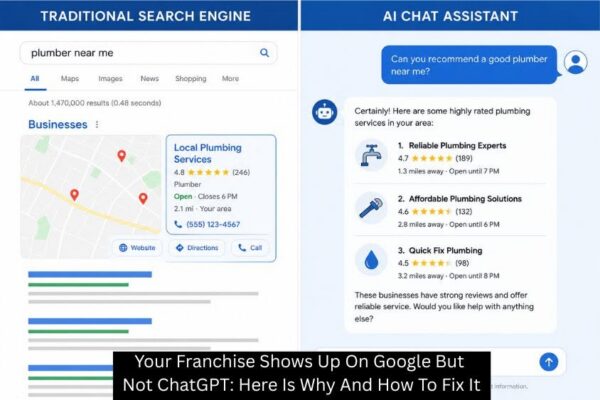
Research from SOCi published in 2026 found that local business searches conducted through AI-powered chat platforms grew from 6% of local searches in January 2025 to 45% in January 2026. For franchise brands, this shift matters because AI search tools surface information differently than traditional search engines do. Instead of returning a ranked list of links, AI search tools synthesize an answer for the user, often drawing from Google Business Profile data, website content, third-party review signals, and other local data sources simultaneously. Franchise brands with inconsistent or inaccurate listing data across their location network are more exposed to this shift than brands with clean, consistent data because AI search tools may synthesize incorrect or contradictory answers about their locations. A system where 20 out of 80 locations have wrong phone numbers or outdated service information in their listings is a system that will produce wrong answers in AI-powered local search results, and the user has no way to know the answer they received was inaccurate.
Can Individual Franchise Locations Run AI-powered Paid Advertising Without Dedicated Marketing Support At The Location Level?
Running AI-powered paid advertising without any dedicated marketing support creates meaningful risk for an individual franchise location, even though the tools themselves are not particularly difficult to activate. The conditions that make automated bidding work, including accurate conversion tracking, sufficient conversion volume to give the algorithm enough signal, well-structured campaigns that separate different services or audiences into appropriate campaign groups, and periodic human review of performance data to catch problems before they compound, require marketing knowledge to set up correctly and to maintain over time. A franchise location that activates automated bidding without those conditions in place is likely to spend budget without producing reliable results, and may not realize the campaign is underperforming until a significant amount of money has already been spent. The more practical approach for franchise locations without in-house marketing staff is to work through the franchisor’s approved marketing partner or a digital agency with documented multi-location franchise experience, so the foundational setup is correct from the start.

CEO & Founder, ClickTecs
Jamshaid (Jam) Hashmi is a serial entrepreneur and franchise digital marketing expert with 25+ years of experience. As CEO & Founder of ClickTecs - North America's leading franchise digital marketing agency - Jam has helped 100+ franchise brands across Canada and the United States grow through SEO, PPC, social media, and AI Search strategies. Previously VP of Development at WSI, where he placed 400+ franchisees, he also co-founded FranchiseSoft, a SaaS franchise management platform. Jam sits on the Marketing & Innovation Committee of the IFA and the Canadian Franchise Association (CFA), and is a sought-after speaker on SEO, franchise lead generation, AEO, and AI for franchising.
Franchise Digital Marketing
Multi-Location SEO
Google Ads PPC
Meta Ads
View Full Profile →