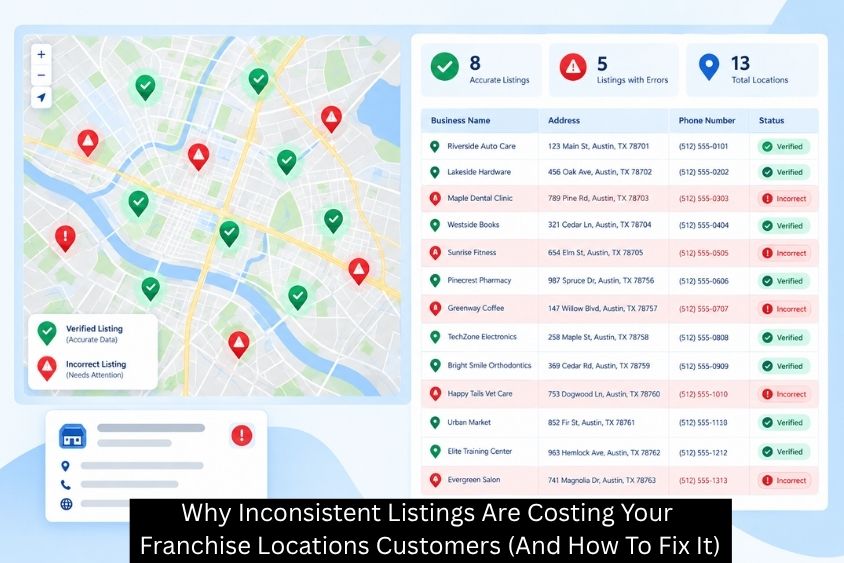
According to SOCi’s 2026 research, 32% of franchise business information appearing on AI platforms like ChatGPT and Perplexity is wrong or outdated. That number deserves a moment of serious attention before you continue reading. Wrong addresses. Outdated phone numbers. Business hours that reflect a schedule from two years ago, still sitting live on a directory nobody thought to update. For a single-location independent business, one inaccurate listing is a manageable problem you can fix in an afternoon. For a franchise system with 75 locations, that 32% figure means roughly 24 of your locations are sending customers somewhere wrong right now, today, at this very moment.
Those customers are not calling back to ask for directions. They are leaving one-star reviews about how they drove across town to an address that no longer exists. Or they are simply opening Google again, finding your competitor, and never thinking about your brand a second time. Either way, you lose the transaction and almost certainly the relationship.
Local listing management for franchise brands is not glamorous work. It does not generate the kind of attention that a new ad campaign does, and it does not produce a single dramatic result you can put in a board presentation. What it does produce is a steady, compounding reduction in customer-facing errors, better local search rankings, and a stronger foundation for the AI-driven search environment that is already here and growing fast. This article explains exactly why listing inconsistencies develop across franchise networks, which directories carry the most weight, how to run a proper audit, and what ongoing systems you need to keep the problem from returning.
What NAP Consistency Means And Why It Matters
NAP stands for Name, Address, and Phone number. These three data points, when they appear consistently across every online platform where your locations are listed, send a meaningful signal to both Google’s local ranking systems and the AI assistants that tens of millions of consumers now use as their first stop for local business information.
The logic behind why consistency matters is straightforward. When Google’s crawlers encounter your franchise location listed as “The Breakfast Spot” in one directory, “The Breakfast Spot LLC” in another, and “Breakfast Spot – North End” in a third, the algorithm cannot be fully certain all three of these entries describe the same physical location. Each variation introduces ambiguity into the system. When there is ambiguity, Google and AI systems reduce their confidence in recommending the business, and lower confidence translates directly into lower local search rankings and reduced AI recommendation frequency.
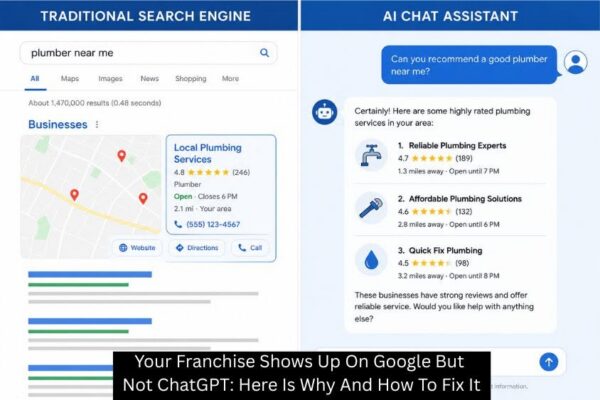
This dynamic has grown significantly more consequential over the past two years because of the rapid rise of AI search. When a consumer asks ChatGPT “where is the closest location to me?” or asks Perplexity “what are the hours for the one near downtown?”, those platforms are not browsing your carefully managed Google Business Profile. They are pulling from aggregated data networks that include dozens of directories, data providers, and structured content sources. If those networks contain errors about your locations, the AI returns those errors to the consumer as confident, authoritative answers.
SOCi’s 2026 research found that only 1.2% of franchise locations appear in ChatGPT results at all. The brands and locations that do appear consistently are those that have built clean, authoritative data signals across the full listing ecosystem, not just the one or two platforms franchisors think to check.
How NAP Inconsistencies Build Up Across A Network
No franchisee sets out to create listing chaos. Inconsistencies accumulate through predictable operational events that individually seem minor but collectively create serious data reliability problems across a large network.
**Location relocations** are one of the most common sources of listing drift. A franchisee moves to a better retail space and updates their Google Business Profile because it is the most visible and the most immediate concern. But Apple Maps, Bing Places, Yelp, and the data aggregators that feed dozens of secondary directories do not send reminder emails. Those platforms continue showing the old address for months or years until someone goes back and corrects them manually. A study of franchise location data consistently shows that the average relocated franchise leaves incorrect address information on at least four major directories for more than six months after the move.
**Phone number changes** create a similar drift pattern. A franchisee switches phone carriers and gets a new local line. A call tracking number gets assigned for a marketing campaign and then left in place on some directories while the main number returns to others. A location consolidates two lines into one. In each scenario, the old number stays on directories that were never updated. Consumers who find that old number reach a dead line, a forwarding message, or worst of all, a competitor who now holds the number.
**Franchisee turnover** introduces a problem that is operationally harder to solve. When a location changes ownership, the outgoing franchisee may have claimed the Google Business Profile listing using a personal email address. The new owner cannot access the listing, cannot make corrections, and may not be able to reach the former operator to transfer access. The result is a frozen listing displaying the previous operator’s information while the new owner is open for business with a different phone number, potentially under a slightly adjusted business name.
**Third-party data aggregators** are the mechanism that most franchise operators do not know about until they discover their listing corrections keep reverting. Companies like Data Axle and Foursquare maintain their own databases of business location information and distribute those records to dozens of directories on a regular refresh cycle. When an aggregator’s records contain outdated information about your locations, those outdated records get pushed downstream to secondary directories every time the aggregator runs a refresh. You can correct a listing on a secondary directory today and find the old wrong data has returned within 90 days because the aggregator overwrote your correction.
Which Directories Matter Most And Why
Not every directory carries equal weight for franchise brands doing local listing management. Understanding the priority structure helps you allocate correction and monitoring resources where they will have the most impact.
**Tier 1 directories are critical and non-negotiable for every location.** Google Business Profile drives the map pack and local search results that appear above organic listings and accounts for the majority of local discovery traffic. Apple Maps is the default navigation application on every iPhone and iPad, covering roughly 55% of the US smartphone market. Bing Places feeds Microsoft’s search ecosystem, including Microsoft Copilot, which is increasingly used in enterprise environments. Facebook Business affects social search visibility and feeds location data to Instagram, which has its own business discovery features.
**Tier 2 directories are important for consumer discovery in specific categories and geographies.** Yelp carries significant weight in food and beverage, health and wellness, and home services, and its data feeds into other platforms including Apple Maps in some contexts. Nextdoor reaches hyperlocal audiences with strong purchase intent and is particularly valuable for service-based franchise categories. Yellow Pages still feeds multiple secondary directories and retains relevance for older consumer demographics.
**Tier 3 directories are critical specifically for AI search visibility**, and this is where most franchise operators have a significant blind spot. Data Axle, Neustar Localeze, Foursquare, and Factual are not consumer-facing platforms that customers visit directly. They are data infrastructure. AI assistants, voice search systems, and in-car navigation platforms pull from these aggregated data networks when constructing their answers about local businesses. Correcting your Google Business Profile without addressing the aggregator layer means AI systems may continue pulling and distributing outdated information about your locations regardless of how carefully you manage your Tier 1 listings. Both layers must be accurate.
How To Run A Franchise Listing Audit Step By Step
A proper listing audit for a franchise network follows a structured process. Working through these steps in order prevents the situation where corrections made early in the process create new inconsistencies because the baseline data was not fully established.
**Step 1: Build a master NAP document with correct data for every location.** Before you can identify what is wrong, you need a single authoritative record of what is correct. For every location in your network, document the exact business name as it should appear on every platform, the complete physical address, the primary phone number, the website URL with correct location-specific path, the primary business category, and current operating hours including holiday variations. This master document becomes your source of truth for every correction and every future audit.
**Step 2: Search each location across all Tier 1 through Tier 3 directories.** Search by business name, by physical address, and by phone number separately on each platform. Phone number searches frequently surface duplicate or unclaimed listings that name searches miss entirely, especially for locations that have changed phone numbers in the past few years.
**Step 3: Document every discrepancy in a structured spreadsheet before making any corrections.** Create columns for the directory name, the location identifier, the type of issue found, the current incorrect data, the correct data from your master document, and a status field for tracking corrections. Do not attempt to fix errors as you discover them during the audit phase. Completing the full documentation first gives you a complete picture of the problem scope before you begin corrections, which prevents you from prioritizing easy fixes while missing systemic issues.
**Step 4: Claim unclaimed listings before attempting corrections.** You cannot correct information on a listing you do not control. Work through the claiming process for every unclaimed listing identified during your audit. On Google Business Profile this typically takes three to seven business days including verification. On some platforms it requires a postcard mailed to the physical address. Build this verification time into your project timeline.
**Step 5: Correct errors using each platform’s native tools or a listing management service.** For networks of 20 or fewer locations, making corrections directly through each platform’s native management interface is practical. For networks larger than 20 locations, a listing management service that maintains direct data feeds to aggregators and offers bulk update capabilities will save significant time and reduce the likelihood of old aggregator data overwriting your manual corrections.
**Step 6: Set up monitoring alerts for changes after the initial correction cycle is complete.** Multiple listing management platforms offer automated monitoring that sends alerts when a listing’s data changes, when a new duplicate listing appears, or when a review is posted. These alerts transform listing management from a reactive cleanup project into a proactive maintenance function.
Building Systems To Prevent Listing Drift
Auditing and correcting your current listings is necessary but not sufficient. Without prevention systems in place, listing drift will begin accumulating again within a few months as normal business operations create new discrepancies.
Every franchise system should maintain a single master location data file that is treated as the authoritative source for all listing updates. When a location’s address, phone number, or hours change for any reason, the change flows from the master file outward to all directories through a defined process, not through individual franchisees independently updating whichever platforms they happen to remember.
Franchisee onboarding should include a dedicated listing setup protocol as a standard component, not an afterthought. New franchisees need clear instructions on which corporate email address to use when claiming their GBP listing (to ensure the brand retains access when ownership changes), how to transfer listing ownership from a previous franchisee, and which platforms require their own account setup. A documented checklist with direct links to each platform’s claim process reduces the likelihood of a new location launching with incomplete or conflicting data.
Quarterly audit cycles, even abbreviated ones focused on Tier 1 platforms, catch drift before it compounds into a significant problem. A structured 30-minute review of each active location’s Tier 1 listings, scheduled four times per year, will identify phone number changes that were not communicated to the marketing team, hours that were updated locally but never reflected in the master file, and new duplicate listings generated by aggregator errors or abandoned franchisee accounts.
The AI Search Connection
The SOCi data points clearly toward a future that is already arriving in meaningful ways. AI assistants are becoming a primary discovery channel for local businesses across nearly every category, and the speed of this shift is accelerating. A consumer who asks a voice assistant where to find a location near them, or who types a question into an AI chat interface, receives a single answer drawn from the same data networks that power traditional local search, combined with additional indexed content those systems have processed.
Every NAP inconsistency across your location network is a data signal that reduces an AI system’s confidence in your locations as reliable, well-maintained businesses worth recommending. Clean, consistent, authoritative location data across all tiers of the listing ecosystem tells these systems your franchise locations are dependable information sources. Inconsistent, conflicting, or outdated data pushes your locations toward the 98.8% of franchise locations that never appear in AI-generated local results at all.
The franchise brands that will build strong AI search visibility over the next three to five years are the ones making data quality investments now, before the competition recognizes what is happening. The gap between brands with clean listing data and brands without it will only widen as AI becomes more central to how consumers find and choose local businesses.
Take Action On Your Franchise Listings
ClickTecs works with franchise brands across North America to audit, correct, and actively manage location data at scale. If you want to know how many of your locations have listing errors right now and exactly where those errors live across the directories that matter most, request a free listing audit at https://clicktecs.net/contact. Our team will map your current data quality and give you a clear, prioritized picture of what needs to be corrected and in what order.
Frequently Asked Questions
How Many Directories Do We Need To Manage For Each Franchise Location?
For complete coverage, each franchise location should be accurately represented across three tiers of directories. Tier 1 includes Google Business Profile, Apple Maps, Bing Places, and Facebook Business. These four platforms drive the majority of direct consumer discovery and local search ranking signals. Tier 2 includes Yelp, Nextdoor, and Yellow Pages, which are important for category-specific visibility and local relevance. Tier 3 includes data aggregators like Data Axle, Neustar Localeze, Foursquare, and Factual. These aggregators feed business data to dozens of secondary directories that you may never visit directly but that AI assistants and voice search platforms draw from regularly. Through aggregator reach, your location data can appear across 50 or more directories, which is why correcting the aggregator layer directly is so important for preventing recurring errors on secondary platforms.
What Is The Fastest Way To Fix NAP Inconsistencies Across A Large Franchise Network?
For networks of 20 or more locations, the most time-effective approach is a listing management platform with direct data submissions to major aggregators and bulk update capabilities across Tier 1 directories. Manual corrections through each platform’s native interface work for small networks but do not scale to larger ones without consuming an impractical amount of staff time. Before using any automated correction tool, build a complete and verified master NAP document for every location in your network. Automated tools push whatever data you give them across the entire network at once. Submitting incorrect data at scale is a more serious problem than the inconsistencies you started with, because it compounds errors rather than resolving them.
Why Do Listing Errors Keep Coming Back Even After We Fix Them?
This is almost always caused by third-party data aggregators. Platforms like Data Axle and Foursquare hold their own records of your locations and push those records to dozens of other directories on regular refresh cycles. If the aggregators hold outdated data for your locations, they will overwrite corrections made directly on secondary directories every time they run a data refresh. The correction must happen at the aggregator level, not just at the visible consumer-facing directory level. Some listing management services include direct aggregator data submissions as part of their service offering, which breaks this cycle by keeping the authoritative source current rather than fighting downstream platforms one at a time.
How Does Listing Inconsistency Affect AI Search Results Specifically?
AI assistants like ChatGPT, Perplexity, and Google’s AI Overviews construct answers about local businesses by drawing from multiple data sources, including aggregated business data networks, indexed web pages, and structured directory data. When they encounter conflicting information about a franchise location across different sources, they either present the most common version of the data (which may still be wrong) or reduce their confidence in the listing and avoid recommending it. SOCi’s 2026 research found that 32% of franchise business information on AI platforms is inaccurate, and only 1.2% of franchise locations appear in ChatGPT results at all. Consistent, verified data across all tiers of the listing ecosystem is the foundation of AI search visibility because it gives these systems the confidence to recommend your locations without uncertainty about whether their information is current.
Who Should Own Listing Management In A Franchise System, The Franchisor Or The Franchisee?
Responsibility works most effectively when the franchisor maintains ownership and control of all Tier 1 platform listings and aggregator data submissions at the network level, while franchisees contribute real-time updates through a defined corporate process rather than managing platforms independently. When individual franchisees own their own GBP listings under personal email addresses, the franchisor loses visibility and access whenever a franchisee departs, which creates the ownership transfer problem that leaves listings frozen with outdated information during every transition. A centrally managed listing structure, where corporate controls the accounts and franchisees have contributor-level access for day-to-day updates like temporary hours changes, produces significantly more consistent data quality and makes ownership transitions far less disruptive to location data accuracy.
How Long Does It Take To See Results After Fixing Franchise Listing Inconsistencies?
Google typically processes GBP updates within one to two weeks, and improvements in local pack or map pack visibility can appear within 30 to 60 days for locations in moderately competitive markets. Locations in highly competitive urban markets may take 60 to 90 days to show ranking movement after a major correction cycle. Aggregator data corrections take 60 to 90 days to fully propagate to secondary directories, and AI platform data may take longer depending on how frequently each system refreshes its underlying business data sources. Setting up monthly monitoring of your rankings and listing data during the correction period helps you track progress and identify any platforms where old data has returned through aggregator refresh cycles. The improvements compound over time as the full listing ecosystem stabilizes around accurate, consistent information.

CEO & Founder, ClickTecs
Jamshaid (Jam) Hashmi is a serial entrepreneur and franchise digital marketing expert with 25+ years of experience. As CEO & Founder of ClickTecs - North America's leading franchise digital marketing agency - Jam has helped 100+ franchise brands across Canada and the United States grow through SEO, PPC, social media, and AI Search strategies. Previously VP of Development at WSI, where he placed 400+ franchisees, he also co-founded FranchiseSoft, a SaaS franchise management platform. Jam sits on the Marketing & Innovation Committee of the IFA and the Canadian Franchise Association (CFA), and is a sought-after speaker on SEO, franchise lead generation, AEO, and AI for franchising.
Franchise Digital Marketing
Multi-Location SEO
Google Ads PPC
Meta Ads
View Full Profile →