Twenty-five years in franchise marketing. I watched SEO become a real discipline, PPC go from a novelty to a core budget line, and social media shift from optional to expected. Each of those changes felt significant at the time. What is happening right now with AI search feels faster and more consequential than any of them. These are my ten predictions for what franchise marketing actually looks like in 2027, based on the data we see across the franchise brands we work with and the direction the signals are pointing.
Before I go into the predictions, I want to be clear about where these opinions come from. I am not a neutral observer. I have a point of view shaped by running campaigns for franchise systems of every size across North America, watching what data actually does versus what the trend pieces say it will do, and sitting in enough board rooms to understand the gap between what franchise executives believe about their digital presence and what is actually happening out in the market. Some of what I am about to say will be uncomfortable for franchise systems that have been comfortable. I think that is worth saying directly.
Prediction 1: GEO Becomes As Important As SEO For Franchise Brands
Franchise brands that have not invested in Generative Engine Optimization by Q1 2027 will find themselves absent from AI-generated local recommendations. This is not a future concern. It is a 2026 priority that most franchise systems are still treating as optional.
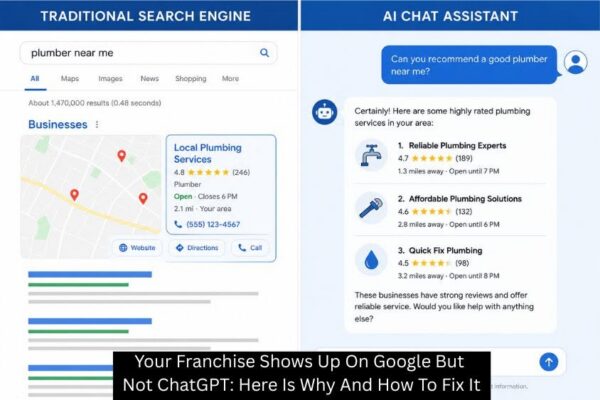
The data on how quickly this has moved is something I share with every client right now. According to SOCi’s 2026 research, ChatGPT local business searches grew from 6% to 45% between January 2025 and January 2026. That is not a gradual trend requiring years of planning. That is a structural shift in consumer behavior happening at a speed I have not seen in two decades of watching this industry. And yet only 1.2% of franchise locations currently appear in ChatGPT results, compared to 35.9% appearing in Google’s Local Pack. The gap between where customers are searching and where franchise brands have a presence is enormous.
The franchise brands building GEO-optimized content, structured schema, and authoritative location data right now will capture that traffic when the volume fully arrives. The ones waiting will find themselves two years behind a trend that already happened.
Prediction 2: Review Velocity Overtakes Star Rating As The Primary Local Ranking Signal
The era of chasing five stars is ending. In 2027, the question will not be “what is your average rating?” The question will be “how many new reviews did you receive this month?”
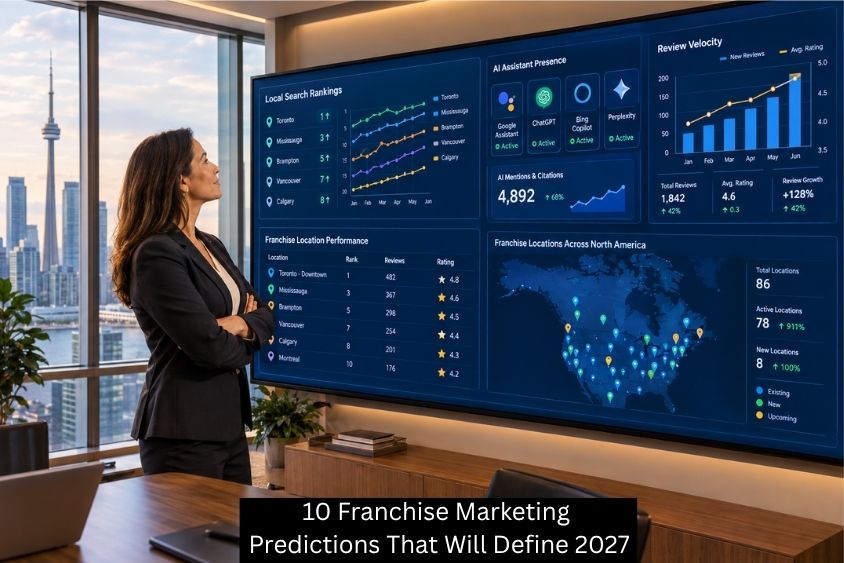
I have watched this shift build for the past eighteen months across the accounts we manage at ClickTecs. Our own data confirms what the algorithms are increasingly weighting: recency and volume of review activity signal that a business is active, engaged, and trusted by the community right now, not two years ago when it opened. A location generating 50 reviews per month at 4.3 stars consistently outranks a competitor sitting at 4.9 stars with 12 new reviews per month.
The SOCi research puts a specific number on this dynamic. A location with a 4.5-star average and 200 reviews outperforms one with a 4.8-star average and only 40 reviews. Franchise systems that have been congratulating themselves on their star rating without building systematic review generation programs are going to feel the ranking impact of that oversight in 2027. Twenty reviews from last month beats 200 reviews from three years ago in terms of the signal it sends to both the algorithm and the AI platform that is trying to decide whether your location is relevant and trustworthy today.
Prediction 3: Franchise Systems With Centralized Digital Marketing Will Dominate AI Results
AI assistants pull from authoritative, consistent data. When a franchise system has 200 locations, each managed by a franchisee who handles their own Google Business Profile, updates their own listing data, and publishes their own location page content without central oversight, what that system produces is noise. Fragmented, inconsistent, often contradictory signals that AI systems are trained to treat as unreliable.
SOCi’s 2026 research puts a number on the problem: 32% of franchise information appearing on AI platforms is wrong or outdated. That is not a data management inconvenience. That is a third of your locations actively pointing potential customers toward the wrong address, the wrong phone number, or the wrong hours, in the channel that is growing fastest for local discovery.
Franchise systems that consolidate under central digital management, with unified listing data, consistent Google Business Profile management, and standardized location page content, will see a measurable advantage in AI search results by 2027. The decentralized systems will lose ground that is genuinely hard to recover once AI platforms have indexed incorrect information and built it into their knowledge base. I have said this to franchise executives who push back on the cost of centralization, and my answer is always the same: the cost of cleaning up the damage from inconsistent data is higher, and it takes longer.
Prediction 4: Voice Queries Through AI Assistants Will Drive 30% Or More Of Local Franchise Queries By End Of 2027
People are already asking their phones, their car systems, and their smart speakers to find local services through AI assistants rather than typing into a search bar. This behavior will be mainstream, not emerging, by the end of 2027.
The conversational nature of voice queries is fundamentally different from typed search queries. Someone typing searches for “oil change near me.” Someone speaking asks “where is the nearest place I can get an oil change that is open right now and has good reviews?” Franchise brands that have not structured their content to answer those specific, contextual, conversational questions will be invisible to a significant and growing share of local search traffic.
I will be honest that 30% may be conservative. The behavioral data on AI assistant usage is moving fast enough that this threshold could arrive earlier than my timeline suggests. What I am certain of is the direction.
Prediction 5: Short-Form Location Video Becomes A Local SEO Differentiator
Google has been factoring video engagement signals into local search rankings with increasing weight. By 2027, a franchise location with four to six short videos published, even videos filmed on a phone of daily operations, staff introductions, or real customer moments, will hold a measurable ranking advantage over competitors with no video presence at all.
I have heard franchisees object to this because they believe video production requires a budget and a professional crew. It does not. It requires consistency and authenticity. A 45-second video filmed on a smartphone showing what a morning opening looks like at a service franchise location does more for local ranking signals than a polished corporate video that never generates location-specific engagement. The franchise systems that build a simple, repeatable video content process at the location level and deploy it consistently will own this differentiator before their competitors recognize it exists.
Prediction 6: Franchise Website Design Shifts To AI-Crawlable First
In 2026 we debate mobile-first versus desktop-first design. In 2027, the primary architectural question for franchise websites will be whether the site is structured so AI systems can parse, understand, and cite it accurately.
What that means in practice: clean page architecture with logical heading hierarchies, LocalBusiness schema on every location page, FAQ schema on every relevant page, clear location data embedded directly in the HTML rather than loaded dynamically through JavaScript, and minimal reliance on JavaScript-heavy rendering frameworks that block AI crawlers from reading content. The websites being built or rebuilt in 2026 need to be designed with 2027 AI crawlability in mind. The ones that are not will require significant rework at exactly the moment when the penalty for being uncrawlable becomes visible in traffic numbers.
Prediction 7: Brands That Have Not Fixed NAP Inconsistencies Will Experience Meaningful Traffic Declines
The 32% wrong-information problem that currently exists on AI platforms will translate into direct, measurable traffic losses in 2027 as more customers rely on AI recommendations to find local franchise locations.
Name, address, and phone number consistency is not a new concept. It has been a local SEO fundamental for years. What changes in 2027 is the consequence of getting it wrong. When a customer asked Google a local question and received an incorrect result, they might try a second search. When a customer asks an AI assistant a local question and receives a confident, specific answer pointing them to the wrong address or a disconnected phone number, they do not search again. They go to a competitor whose information was correct. The brands with clean, consistent listing data will hold or grow their share of AI-referred local traffic. The brands with fragmented, contradictory data across platforms will lose customers they never even know they lost.
Prediction 8: Human-Written, Experience-Based Content Commands A Premium
As AI-generated content floods every category online, including franchise marketing content, the systems that distinguish authentic expertise from machine-produced text will do more of that filtering, not less. Google’s E-E-A-T framework, which weights Experience, Expertise, Authoritativeness, and Trustworthiness, was built precisely for this moment.
Content written by a real person who has actually done the work they are describing, supported by specific data, real case study numbers, and genuine on-the-ground knowledge, will build an authority signal that mass-produced AI content structurally cannot replicate. I say this as someone who uses AI tools regularly in my own work. I understand the efficiency argument. But there is a meaningful difference between using AI to assist in content production and using AI to replace the thinking that makes content worth reading and worth citing. Franchise brands that invest in genuine thought leadership, real operators sharing real experience, will build a compounding authority advantage in 2027. The ones publishing AI-generated filler at scale will find themselves commoditized at exactly the wrong moment.
Prediction 9: First-Party Data Becomes The Franchise Marketing Moat
When third-party cookies are fully deprecated and AI platforms pull customers away from open search into closed conversational interfaces, the franchise brands with strong direct customer relationships will have a marketing channel that no algorithm change can affect.
Email lists, SMS subscribers, loyalty program members, direct app users: these are audiences a franchise brand owns outright. They are not rented from a search engine or borrowed from a social platform. When paid and organic channels get disrupted by the next wave of AI search behavior changes, and they will, the brands with strong first-party data have a fallback position that takes years to build and is genuinely difficult for competitors to replicate quickly. Building first-party data infrastructure is no longer a CRM project that lives in the operations department. It is a competitive survival strategy that belongs in the marketing plan with a real budget behind it.
Prediction 10: Franchise Marketing Budgets Shift From Paid Search To AI Visibility Programs
Google Ads will not disappear in 2027. I am not predicting that. But the share of franchise marketing budgets allocated to paid search will decline as more franchise executives recognize a fundamental reality: AI visibility is earned through organic signals, not purchased through paid placement.
The marketing investments with the strongest return in 2027 will be listing cleanup and maintenance, systematic review generation programs, schema implementation across location pages, E-E-A-T content that demonstrates genuine expertise, and consistent Google Business Profile management across every location. These are organic investments. They compound over time. They build an asset the brand owns rather than renting traffic from an advertising platform.
Franchise Business Review research indicates that 88% of franchise brands will use at least one AI marketing tool by the end of 2026. The question is whether those tools are being used to do more of what already worked, or to actually adapt to where the market is going. The brands reallocating budget toward AI visibility programs in 2026 will see the return of that decision clearly in 2027. The ones doubling down on paid search alone, without building any organic foundation underneath it, will see diminishing returns on channels that are losing share of consumer intent.
Where I Stand Going Into 2027
I have watched this industry long enough to know that predictions are exercises in educated confidence, not certainty. Some of what I have written here will prove directionally accurate but arrive on a different timeline. Some of it may move faster than I have projected. What I am certain of is the underlying structural reality: AI search is not a trend that will plateau. It is a transition in how people find local businesses, and franchise brands have a specific and meaningful vulnerability to that transition because of the data fragmentation that comes with multi-location systems.
If one prediction in this list resonates with you, I would genuinely like to know which one. If one seems wrong, I want to hear that argument directly. The only way to think through this clearly is to push the ideas against people who have strong opinions about them.
If you want to talk through what any of these predictions mean for your specific franchise system, I am at https://clicktecs.net/contact/and I have a real conversation to offer, not a sales presentation.
Frequently Asked Questions
A Question I Get Often From Franchise Executives Is: How Do We Even Know If We Appear In AI Search Results?
It requires manual testing, and it is more systematic than it might sound. Start by asking ChatGPT, Google’s AI Overview, and Perplexity the same questions your customers would ask to find your category of service in three or four of your key markets. Note whether your locations appear, what information is cited, and whether that information is correct. Then run the same test across your ten weakest-performing markets. The gap between what you find and what you expected to find is your GEO audit starting point. We run this as a structured audit for franchise brands, and the results are consistently eye-opening for teams that have never done it before.
Franchise Marketers Frequently Ask Me Whether They Should Stop Investing In Google Ads Given The AI Search Shift.
No, and I want to be direct about that. Stopping paid search entirely would be a mistake. The shift I am predicting is a rebalancing of budget, not an abandonment of paid channels. The question I would ask every franchise marketing team is: what percentage of your current marketing budget produces results that compound over time versus results that stop the moment you stop paying? If the answer to the compounding category is close to zero, that is the problem to solve. Building AI visibility through organic signals, consistent listings, review programs, and quality content creates a foundation that paid search can then amplify effectively. The brands that will struggle are the ones relying on paid search as their only strategy with no organic foundation underneath it.
A Question I Receive From Franchisors Building New Systems Is: What Should Our Location Pages Include To Perform Well In AI Search?
Every location page needs to function as a standalone answer to the most common questions a customer would ask about that specific location. That means the location name, full address, phone number, and hours need to be in the HTML, not loaded dynamically through JavaScript. It means LocalBusiness schema with every available property filled out correctly. It means a short descriptive section answering “what does this location do and who does it serve?” in plain language. It means FAQ schema covering the three to five questions customers most commonly ask about that service in that market. Pages built with this structure consistently perform better in both traditional local search and AI-generated local recommendations. I have watched this play out across enough clients that I consider it one of the clearest cause-and-effect relationships in our current work.
Franchise Executives Frequently Ask Me How To Get Franchisees To Participate In Review Generation Programs When Franchisees Are Already Stretched Thin Operationally.
This is less a marketing problem and more a system design problem. Review generation needs to be embedded in the operational workflow rather than added as a separate marketing task on top of everything else. The highest-performing programs I have seen build the review request directly into the transaction itself, whether that is a post-service email triggered automatically by the POS system, a follow-up text sent after job completion, or a simple card handed to customers at the moment of highest satisfaction. When the request happens as a natural part of the service experience and does not require the franchisee to remember to initiate it, participation rates go up significantly and stay up. The franchisee’s job is to ensure the trigger is set up correctly. The system does the rest consistently.
A Question I Get From Franchise Development Teams Is: Do AI Search Results Affect Whether Prospective Franchisees Consider Investing In A System?
Yes, and this is one of the more underappreciated implications of the AI visibility gap. A prospective franchisee doing due diligence on a franchise system is absolutely asking AI assistants questions about the brand, the category, and the markets they are considering. If the brand does not appear authoritatively in those results, or if the information that does appear is inconsistent or outdated, that creates doubt at a critical decision point. Franchise development teams that think about AI visibility only in terms of customer acquisition are missing half the story. Your digital authority and data accuracy affect how sophisticated prospective franchisees perceive the professionalism and credibility of your system.
Franchise Marketers Frequently Ask Me Which Of These Ten Predictions Is The Most Urgent To Act On Right Now.
Prediction 7, the NAP inconsistency problem, because it is the one where inaction creates compounding damage that is genuinely difficult to reverse. Wrong information on AI platforms gets indexed, gets incorporated into AI training data, and gets replicated across the web over time. Cleaning it up after the fact requires significantly more effort than preventing it in the first place. If I were advising a franchise system with limited budget and limited bandwidth, I would tell them to audit their listing data across every major platform and every location before doing anything else. That foundation has to be clean before any other investment in GEO, video, schema, or content can reach its full potential. Get the data right first. Everything else builds on top of that.

CEO & Founder, ClickTecs
Jamshaid (Jam) Hashmi is a serial entrepreneur and franchise digital marketing expert with 25+ years of experience. As CEO & Founder of ClickTecs - North America's leading franchise digital marketing agency - Jam has helped 100+ franchise brands across Canada and the United States grow through SEO, PPC, social media, and AI Search strategies. Previously VP of Development at WSI, where he placed 400+ franchisees, he also co-founded FranchiseSoft, a SaaS franchise management platform. Jam sits on the Marketing & Innovation Committee of the IFA and the Canadian Franchise Association (CFA), and is a sought-after speaker on SEO, franchise lead generation, AEO, and AI for franchising.
Franchise Digital Marketing
Multi-Location SEO
Google Ads PPC
Meta Ads
View Full Profile →